Table of Contents
If you only read one section, read this. A typical China→US Amazon FBA shipment is a short workflow plus two big choices: your route (ship direct vs consolidate/prep first) and your shipping mode (ocean/air/express).
Two decision rules you can use immediately
Quick compare (no prices, no transit-time guesses)
Important notes before we go deeper
Now that you have the snapshot, here’s the full workflow. Most China→US FBA shipments follow the same backbone steps; the differences are where you insert a consolidation/prep checkpoint and which transport mode you choose.
With the workflow in mind, “door-to-door” is typically a bundle of services rather than a single thing. It often includes pickup, export-side handling, main transport, import clearance handoff, and final delivery—but you still need to confirm exactly what your quote covers.
What is commonly included (conceptually)
What you must confirm before booking
The easiest way to prevent expensive surprises is to check handoffs. Use this checklist at the points where responsibility changes hands and small mismatches become big rework.
Handoff checklist (quick risk scan)
After you understand the workflow, the first big decision is where you want control. Ship direct to FBA when execution risk is truly low; use consolidation/prep first when complexity or uncertainty is high and you want a checkpoint before inventory hits Amazon.
Decision table: scenario → recommended route
If you ship direct-to-FBA, make sure these are true
If you consolidate/prep first, set up these controls
If you’re planning your first China→US FBA shipment or consolidating multiple suppliers, FBABEE can help coordinate China-side receiving, prep, and door-to-door delivery—so your shipment plan, labels, and carton mapping stay aligned end to end.
Once your route is decided, mode selection is the next biggest lever. Choose ocean, air, or express based on urgency, shipment size, and operational constraints—not “typical days” or generic price claims.
Comparison table: ocean vs air vs express (criteria-based)
Decision rules (simple, non-numeric)
Boundary conditions that change the answer
After comparing the three main modes, the sub-choices become clearer. For ocean, the key question is whether you share a container (LCL) or use a full container (FCL); for air, the key question is whether you’re shipping parcel-style (express) or freight-style (air cargo).
LCL vs FCL (ocean)
Express vs air cargo
If you’re comparing modes, the fastest way to get a usable plan is to standardize your carton data (count, dimensions, weights) and define your target route (direct vs consolidate). That lets a forwarder/prep partner sanity-check scope without “guessing” numbers.
After choosing route and mode, you must lock down customs roles. Someone must be the Importer of Record (IOR) for US imports, and clarity here prevents last-minute “scope surprises” that stall your shipment.
Practical role map (high level, not legal advice)
Step-by-step: customs setup without guessing
Docs + data checklist (prepare-before-booking)
Two scope questions that prevent most surprises
The most useful “speed lever” is better data. Collect this minimal package from every supplier so you can quote and plan without rework.
With shipping and customs set, the next major risk is Amazon receiving rework. Most preventable problems come from label-layer confusion, scannable “extra barcodes,” and packaging that doesn’t match the inbound setup you chose.
Common pitfalls (problem → impact → prevention)
Quick “pre-flight” checks (use before inventory leaves China)
If you only remember one thing, remember this: label “layers” exist because different parts of the process scan different things. Keep the layers separate and verify your exact label outputs in Seller Central before printing.
What to check before printing
Once you know the risks, you can vet partners based on evidence, not promises. The best forwarder/prep partner is the one who can show process controls that match your shipment complexity.
Proof-based checklist (ask for artifacts, not guarantees)
Red flags (usually worth walking away from)
If you source from multiple factories, consolidation is the control point that makes everything else safer. A good consolidation workflow is a series of predictable checks that protect carton mapping and labeling before outbound booking.
A simple consolidation workflow (6–9 steps)
Mapping controls that prevent “inventory mystery” later
Incoterms help you translate a quote into responsibilities. They don’t automatically guarantee what your provider includes—so use them as a map, then verify the actual scope line by line.
Responsibility map (practical, simplified)
Quote-audit checklist (prevents scope gaps)
If you’re choosing between program shipping and an independent forwarder, focus on fit. Amazon Global Logistics (AGL) is designed to integrate booking and tracking inside Seller Central; independent workflows can be better when you need flexible consolidation/prep and custom exception handling.
Comparison table: AGL vs independent forwarder (scenario-based)
Two practical questions to decide
Q: What’s the step-by-step process to ship inventory from China to US Amazon FBA? A: The backbone is: confirm carton data → draft your shipment plan → choose route (direct vs consolidate) → choose mode (ocean/air/express) → confirm IOR/broker roles → ship → clear customs → appointment delivery → Amazon check-in. Exact steps depend on your mode and whether you add a China-side prep checkpoint.
Q: Can I ship directly from my China supplier to Amazon FBA, or should I use a prep/consolidation step first? A: You can ship direct if labeling, packaging, and carton mapping are reliably correct at the factory and you can handle exceptions before delivery. Use consolidation/prep first when you have multiple suppliers, mixed SKUs, bundles, or low tolerance for rework risk after the shipment is already in transit.
Q: Ocean vs air vs express: how do I choose for my shipment size and replenishment speed? A: Pick ocean when you can plan ahead and volume is higher; pick air cargo when speed matters but you still need freight handling; pick express for small urgent replenishments with simpler handoffs. Don’t decide on “typical days”—use urgency, volume, and constraints (product type, carton data accuracy) instead.
Q: What is the Importer of Record (IOR) and why does it matter for US FBA shipments? A: The IOR is the party responsible for import compliance and the customs entry process. It matters because it defines who must provide accurate documentation and who ultimately carries responsibility for duties/fees and compliance outcomes. Your broker can help, but the IOR role should be explicitly confirmed before booking.
Q: What documents do I typically need for China → US Amazon FBA shipping? A: At minimum, expect a commercial invoice and packing list, plus accurate carton data and a SKU list you can map to cartons. Your customs broker may require additional product-category documents. Treat “docs needed” as setup-specific—confirm your exact requirements early to avoid clearance delays.
Q: What Amazon labeling/packaging mistakes most often lead to relabeling, delays, or returns? A: The most common preventable issues are label-layer confusion (unit vs box vs pallet), conflicting scannable barcodes left exposed, and carton mapping that doesn’t match what you shipped. Prevent these by verifying label outputs in your shipment workflow, standardizing carton mapping, and spot-checking packaging before outbound.
Q: What do EXW, FOB, and DDP mean in practice when shipping to Amazon FBA? A: They’re Incoterms that help describe where responsibility shifts between buyer and seller. EXW pushes most logistics to the buyer; FOB is a sea-focused handoff around port loading; DDP implies delivery with duties paid. They don’t replace your quote—verify pickup, clearance, IOR, duties handling, and final delivery scope in writing.
Q: How do I vet a freight forwarder/prep partner for Amazon FBA (what proof should I ask for)? A: Ask for proof artifacts: a sample receiving/exception report, how they manage label files and carton mapping, and how they document issues before outbound. Confirm scope line by line (pickup, prep, customs handoff, appointment delivery) and avoid providers who rely on “guarantees” instead of showing controls and examples.
If you want a reliable plan, start by tightening inputs and decisions. Your next best steps are: confirm carton data, choose route and mode based on complexity and urgency, lock down IOR/broker roles, and verify labels/carton mapping before anything leaves China.
Checklist
When it’s your first shipment, multi-supplier consolidation is involved, or you’re doing kitting/prep, a China-side control point can prevent avoidable downstream rework. If you want help structuring pickup→prep→shipping→FBA delivery as one workflow, FBABEE can support end-to-end coordination.
Back to top
Your email address will not be published. Required fields are marked *
Comment *
Name *
Email *
Save my name, email, and website in this browser for the next time I comment.
Δ
This site uses Akismet to reduce spam. Learn how your comment data is processed.
What Are FBA Shipment Splits? Amazon FBA shipment splits are inbound placement options that may send your inventory to one ...
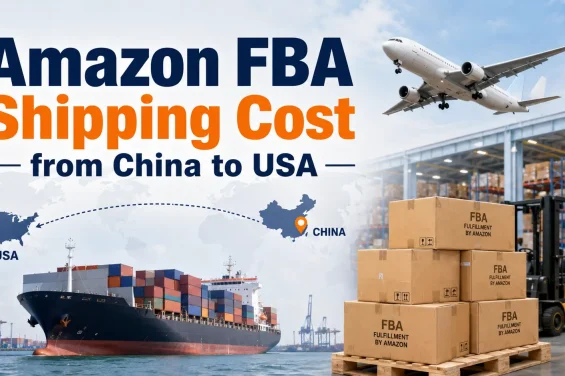
Shipping from China to Amazon FBA in the USA rarely has one fixed price. Two sellers can ship similar products ...
Table of Contents Heavy box label decision + placement Terms that get mixed up: Team Lift vs Heavy Package vs ...