

If you’ve heard “Amazon FBA can make you rich,” you’ve probably also seen wildly different results—some sellers thriving, others losing money fast. The truth is more practical: FBA is a fulfillment method that can support a profitable business, but only when the economics and execution hold up.
This guide explains FBA in plain English, shows you what to model before you spend on inventory, and walks through the first-shipment workflow—especially if you source from China.
Amazon FBA + Profit Reality Check (No Hype)
Amazon FBA (Fulfillment by Amazon) is a service where you send inventory to Amazon, and Amazon stores it and fulfills customer orders—while you still own product selection, pricing, compliance, and profitability. Amazon can help you scale fulfillment, but it cannot make a product profitable by itself. Learn more from Amazon’s FBA overview: Fulfillment by Amazon (FBA).
Here’s the fastest way to think about “can it make you rich?” without the hype:
| Question | Quick, realistic answer | What to do first |
|---|---|---|
| What is FBA? | Amazon stores, picks, packs, ships, and handles customer service/returns for eligible orders. | Confirm what Amazon handles vs what you must handle. |
| Can it make you rich? | Sometimes—if your unit economics, demand, and execution are strong. There’s no guarantee. | Model all-in costs and test with a small, controlled shipment. |
| What determines profit? | Margin after all costs (including inbound shipping and prep), plus demand, competition, ads efficiency, and returns. | Use Amazon’s tools to estimate fees and build a simple all-in cost stack. |
Key reminders (so you don’t overestimate results):
- FBA is not “passive income.” It’s fulfillment outsourcing, not a business model.
- Profit depends on your product and execution: costs, differentiation, cash flow, and operational accuracy.
- Fees and requirements vary by category, size/weight, and settings; verify your current inputs in Seller Central and Amazon’s fee estimation tools: Estimate fees and costs.
With that foundation, it helps to start with a clear definition of what FBA is—and what it is not.
What Is Amazon FBA? (Plain-English Definition + Who Does What)
Amazon FBA is a program that lets sellers send inventory into Amazon’s fulfillment network so Amazon can store it and fulfill orders (pick, pack, ship), along with customer service and returns for eligible orders. Amazon’s own description is a good baseline: Fulfillment by Amazon (FBA).
What Amazon typically handles (in FBA):
- Storage of your inventory in fulfillment centers
- Order fulfillment (picking, packing, shipping)
- Customer service and returns handling for eligible orders
What you still handle as the seller:
- Product choice, positioning, and pricing
- Sourcing, quality control, and compliance (what you sell and whether it meets requirements)
- Inventory planning (avoiding stockouts and overstock)
- Profitability (your margin after all costs, including ads and returns)
Boundary conditions that matter:
- Fees and service details depend on product attributes and your selling setup; always verify current details.
- FBA improves fulfillment operations, but it doesn’t create demand or guarantee profit.
Before you think about profit, it helps to understand the basic inventory flow.
How FBA Works in 3 Steps (Inventory Flow)
FBA is simple at a high level:
- You prepare inventory and create an inbound plan, then send units to Amazon.
- Amazon receives the shipment and stores your inventory in fulfillment centers.
- When customers order, Amazon picks, packs, ships, and handles customer service/returns for eligible orders.
That flow is straightforward—but the details around inbound planning and labeling can cause the biggest beginner problems.
Where the Shipping Plan Fits (Why It Affects Labels and Cartons)
Your inbound workflow is not just “ship to Amazon.” The shipment plan you create in Seller Central influences:
- Which labels are required and what they must match
- How cartons and quantities are tracked
- How receiving can be verified against what you said you sent
This is why prep and carton planning are not “nice-to-have”—they’re part of avoiding discrepancies and rework. Packaging and barcode rules are documented in Seller Central help pages such as: Product packaging requirements.
With the mechanics clear, you can talk about money in a way that stays grounded.
Can Amazon FBA Make You Rich? A Reality Check on What Drives Profit
Amazon FBA can support a highly profitable business for some sellers, but “rich” depends on assumptions: your margin after all costs, demand, competition, ad efficiency, and how well you execute. FBA can reduce fulfillment friction, yet profitability still comes from your product and business decisions—not the fulfillment method alone.
Here’s the realistic way to frame it:
- Strong products with healthy margins can scale faster with FBA because fulfillment is smoother.
- Weak unit economics get exposed quickly because FBA adds fees and inventory carrying costs.
- Execution mistakes (prep, labels, cartons, inbound planning) can wipe out profit through rework and delays.
Common reasons beginners lose money (even if sales look “good”):
- Incomplete cost modeling (they ignore inbound shipping, prep labor, storage, returns, or ads)
- No differentiation (competing on price without a reason to win)
- Over-ordering inventory (cash tied up, storage costs rising, slower sell-through)
- Treating FBA as passive (underinvesting in listing quality, customer feedback, and problem-solving)
Boundary conditions:
- Results vary widely by category and operator skill; there is no universal income outcome.
- Any “earn $X per month” claim requires clear assumptions and a full cost model.
To keep expectations practical, separate what you can control from what you can’t.
Controllables vs Uncontrollables (A Quick Framework)
Controllables (you can influence directly):
- Your landed cost (product + inbound shipping + prep)
- Listing quality, offer positioning, and pricing strategy
- Packaging quality and labeling accuracy (reduces inbound friction and damage)
- Inventory planning (test batches vs scaling)
- Advertising strategy and conversion improvements
Uncontrollables (you can’t fully control):
- How competitive a niche becomes
- Changes in fees, policies, and marketplace behavior
- Seasonality and shifts in customer demand
- Competitors’ pricing, promotions, and copycat products
This framework keeps “rich” grounded in practical levers—so the next step is to model the economics honestly.
Costs & Fees: Build a Simple Amazon FBA Profitability Model (All-In)
To estimate profitability, you need an all-in cost stack: product cost + inbound shipping + prep + Amazon selling and fulfillment fees + operating costs like ads and returns. Amazon provides tools to estimate fees and compare fulfillment methods, including the FBA Revenue Calculator: Estimate fees and costs and FBA Revenue Calculator.
Two principles keep the math honest:
- Model what you actually pay, not what you hope you’ll pay.
- Include the costs that show up later (ads, returns, storage, rework).
All-In Cost Checklist Table (What to Include, What People Miss)
Use this as a decision tool before you commit to inventory:
| Cost bucket | What to include (examples) | Why it surprises beginners |
|---|---|---|
| Product cost | Unit cost from supplier, packaging materials, inserts (if used) | Packaging upgrades often arrive after the first defects/returns |
| Inbound shipping (to Amazon) | Freight from factory/warehouse to destination, delivery to Amazon, handling | Many calculators ignore cross-border shipping or treat it as “misc” |
| Prep & labeling | Label printing/application, poly-bagging, bundling/kitting, carton prep | Small prep errors can trigger rework or delays that cost money |
| Amazon selling fees | Category-based selling fees and related charges | “Amazon takes X%” depends on fee type and product category |
| Fulfillment fees | Fees tied to picking/packing/shipping based on size/weight | Products with awkward dimensions can change economics quickly |
| Storage & inventory carrying | Storage fees, long-term inventory risk, cash tied in inventory | Overstock can cost more than expected and reduce flexibility |
| Returns & damage | Return processing, unsellable units, replacements | Return rates can turn “profit” into break-even |
| Advertising & promotion | PPC spend, coupons, promo costs | Many niches require sustained ad spend to compete |
| Operational buffer | Rework, relabeling, inspection, removals | Ignoring “messy reality” costs makes plans fragile |
Where to verify fee inputs:
- Use Amazon’s fee estimation entry points and tools: Estimate fees and costs.
- For fulfillment-fee concepts and how fees vary, Seller Central help pages explain the dependency on category/size/weight: FBA fulfillment fee.
Boundary conditions:
- Fees and programs can change; always verify current values before placing large orders.
- The goal isn’t perfect prediction; it’s avoiding a false “profitable” signal caused by missing costs.
Once your cost stack is complete, you can answer the common “how much does Amazon take?” question in a way that doesn’t rely on a single misleading number.
“Amazon Takes X%” — Why It Depends (A Simple Way to Estimate Without Guessing)
There isn’t one universal “Amazon takes X%” answer, because fees depend on product category and attributes (including size/weight) and your selling setup. A safe approach is to estimate by inputs:
- Identify the category and your expected selling price.
- Confirm your product’s packed dimensions and weight (what actually ships).
- Use Amazon’s tools to estimate fees for your situation: Estimate fees and costs.
- Add your non-Amazon costs (landed cost, ads, returns buffer) using the checklist table above.
- Stress-test your assumptions: what happens if ad costs rise, return rates increase, or shipping costs change?
This keeps the decision grounded in your controllables rather than a one-number shortcut.
With costs mapped, the next decision many beginners face is fulfillment approach.
FBA vs FBM vs Outsourcing (3PL / Prep Center): How to Choose
Beginners usually choose between FBA and FBM (Fulfillment by Merchant), and sometimes a hybrid with a 3PL or prep partner. The right choice depends on your product, volume, and operational capacity—not on what sounds “easier.”
| Option | Best for | Pros | Cons | When it breaks |
|---|---|---|---|---|
| FBA | Products that benefit from Amazon fulfillment and scalable operations | Amazon handles fulfillment and customer service/returns for eligible orders; operational scale | Fees and inbound requirements add complexity; inventory planning matters | Tight-margin products with high return risk or high inbound friction |
| FBM | Sellers who want direct control over fulfillment or have specialized handling | Control over packing, inserts, timing; can be cost-effective in some scenarios | You handle shipping speed and customer experience; more operational load | Scaling volume without systems/automation |
| 3PL + FBA/FBM hybrid | Brands that want flexibility and redundancy | Can split inventory, manage multiple channels, and reduce single-point risk | Added coordination and fees; requires clear SOPs | Poor inventory visibility or unclear workflows |
| China-side prep + forwarding | Sellers sourcing from multiple suppliers | Consolidation, inspection, and prep can reduce inbound errors before goods ship | Requires a reliable process partner; needs clear specs | Vague specs, changing SKUs, or inconsistent supplier communication |
Boundary conditions:
- No one-size-fits-all rule; test with a small batch before scaling.
- If you source from China, inbound logistics and prep accuracy often matter as much as the Amazon fee model.
To put all of this into action, a clear first-shipment roadmap helps.
Step-by-Step: From Product Idea to Your First FBA Shipment (With Checkpoints)
A first successful shipment usually comes from a simple sequence: validate the product idea, lock specs, build the listing, plan prep and inbound, then ship a small test batch. The objective is learning with controlled risk, not “going big” immediately.
The 9-Step Roadmap (Idea → Ready-to-Ship → Amazon Receives)
- Choose a product concept and define the customer problem it solves.
- Validate demand and competition at a high level (avoid over-optimizing this step).
- Source suppliers and request samples; confirm your specifications.
- Decide your packaging and labeling approach (what must be on the unit and cartons).
- Build your listing assets (title, bullets, images) and confirm compliance requirements.
- Estimate all-in economics using the cost checklist (include inbound shipping, prep, ads buffer).
- Create your inbound plan and align it with your prep/carton plan.
- Prepare inventory (prep, labels, carton plan) and ship a small test batch to Amazon.
- Monitor receiving, listing performance, returns, and ad performance; then iterate before scaling.
Boundary conditions:
- Some categories require extra compliance steps; confirm requirements early rather than after production.
Small process mistakes can compound, so checkpoints matter before anything ships.
Minimum Checkpoints Before You Ship (Beginner-Safe)
Use this checklist before inventory leaves your supplier or warehouse:
- Specs locked: color, size, materials, pack count, and any bundle configuration
- Unit barcode/label is scannable and placed consistently (per your plan): Product packaging requirements
- Carton contents match what you intend to send (counts and SKUs are consistent)
- Carton labels and shipment labels are correct and readable (no smudges, no mismatches)
- Packaging is protective enough for handling and transit (no “fragile hope” packaging)
- Documents and shipping details are prepared and shared with the shipping partner
- You have a clear point of contact for exceptions (missing units, damage, label mismatches)
These checkpoints become even more important when inventory crosses borders.
Shipping from China to Amazon FBA (US): Handoffs, Options, and What to Prepare
Shipping from China to Amazon is manageable when you treat it as a handoff chain: supplier → consolidation/prep → export → import/customs → delivery → Amazon receiving. The most common failure mode is not choosing the “wrong” shipping method—it’s missing a handoff requirement (labels, carton plan, documents) that causes rework or delays.
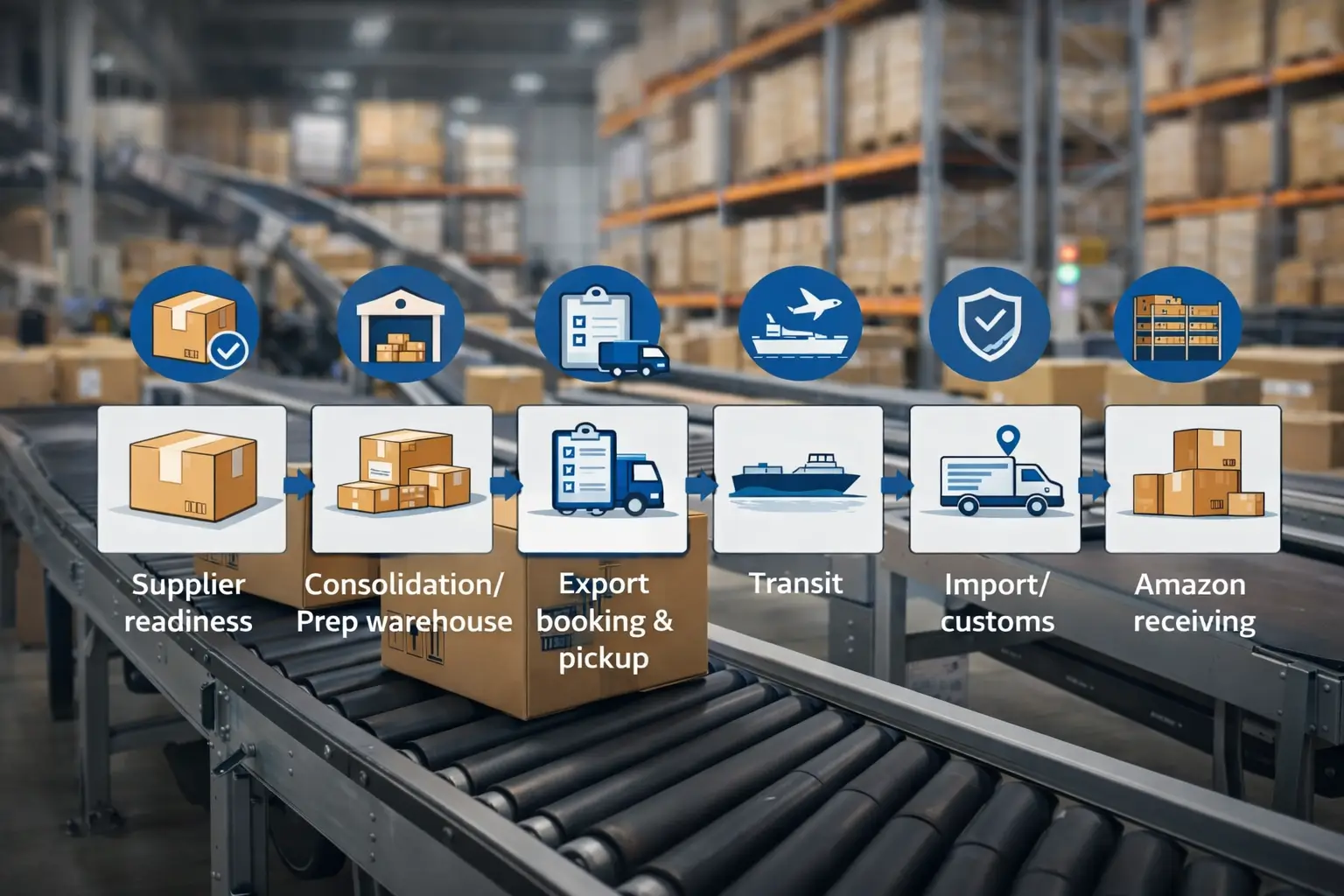
China → FBA Handoff Map (Factory → Prep/Warehouse → Export → Import → Delivery → Amazon Receiving)
A practical handoff map looks like this:
- Supplier readiness: products packed to spec, counts confirmed, cartons sealed and marked.
- Consolidation/prep warehouse: combine multiple suppliers, verify counts, apply prep and labels, finalize carton plan.
- Export booking and pickup: shipment is booked and collected for departure.
- Export and transit: goods move via the chosen mode (sea/air/express) with tracking and documentation.
- Import/customs clearance: required import steps are handled (often via a broker/partner depending on setup).
- Last-mile delivery to Amazon: delivery is scheduled and labels must match Amazon’s receiving expectations.
- Amazon receiving: inventory is checked in and becomes available for fulfillment.
Why this matters:
- Each handoff is a chance to catch errors before they reach Amazon receiving, where fixes are slower and can cost more.
For carton and routing expectations (especially for pallets and labeling), Amazon documents routing and labeling requirements in Seller Central help content such as: Shipping and routing requirements.
Sea vs Air vs Express (How to Decide Without Guesswork)
Use your constraints—not hype—to choose the method:
| Method | When it often makes sense | Trade-offs | Common gotchas |
|---|---|---|---|
| Sea freight | Lower urgency, larger volume, cost-sensitive shipments | Slower; more planning needed | Poor carton planning or late changes can cause major rework |
| Air freight | Medium urgency or moderate volume | Costs more than sea; still needs prep accuracy | Underestimating dimensional weight impact on economics |
| Express | Highest urgency, small test batches, emergency replenishment | Highest cost per unit | Easy to “save time” but destroy margin if used by default |
Decision cues that keep you honest:
- If you’re testing a new product, prioritize learning speed with a small batch, but still run the all-in cost model.
- If margins are tight, pressure-test inbound cost sensitivity before committing to faster methods.
- If you have multiple suppliers, consolidation and carton planning often reduce surprises more than “faster shipping” does.
Documents and Information to Gather (High Level)
Exact requirements vary by product type and destination, but you’ll typically need:
- Commercial invoice and packing list (high-level basics)
- Accurate carton counts and unit counts per SKU
- Product dimensions/weight (what ships, not what the factory “estimates”)
- Labeling plan (unit labels and carton/shipment labels)
- Delivery information required by the carrier/last-mile partner
Boundary conditions:
- Documentation needs can change by product category and import setup; verify requirements for your scenario.
Where Consolidation Helps (Especially with Multiple Suppliers)
Consolidation is often worth it when:
- You source from multiple factories and need one coherent carton plan
- You want to verify counts and packaging before goods leave China
- You need consistent labeling and bundling across suppliers
It’s less critical when:
- You have one reliable supplier with stable quality and simple SKUs
- Your packaging and labeling process is already consistent and verified
If you’re coordinating multiple suppliers in China—or sending your first shipment—having a clear consolidation and prep workflow can reduce avoidable inbound issues (label mismatches, carton content discrepancies, and last-minute rework). FBABEE supports China-side consolidation, inspection, and FBA prep so shipments are ready before they head to Amazon. Learn more at https://fbabee.com/.
Once your shipping flow is mapped, preventing receiving problems becomes much easier.
Avoid Receiving Problems: Prep/Labeling + Inspection + Common Mistakes (Fast Prevention)
Most receiving headaches come from a small set of preventable issues: unclear labeling, carton content mismatches, weak packaging, and missing checks before shipping. A simple prevention checklist is often more valuable than another “how to get started” blog post.
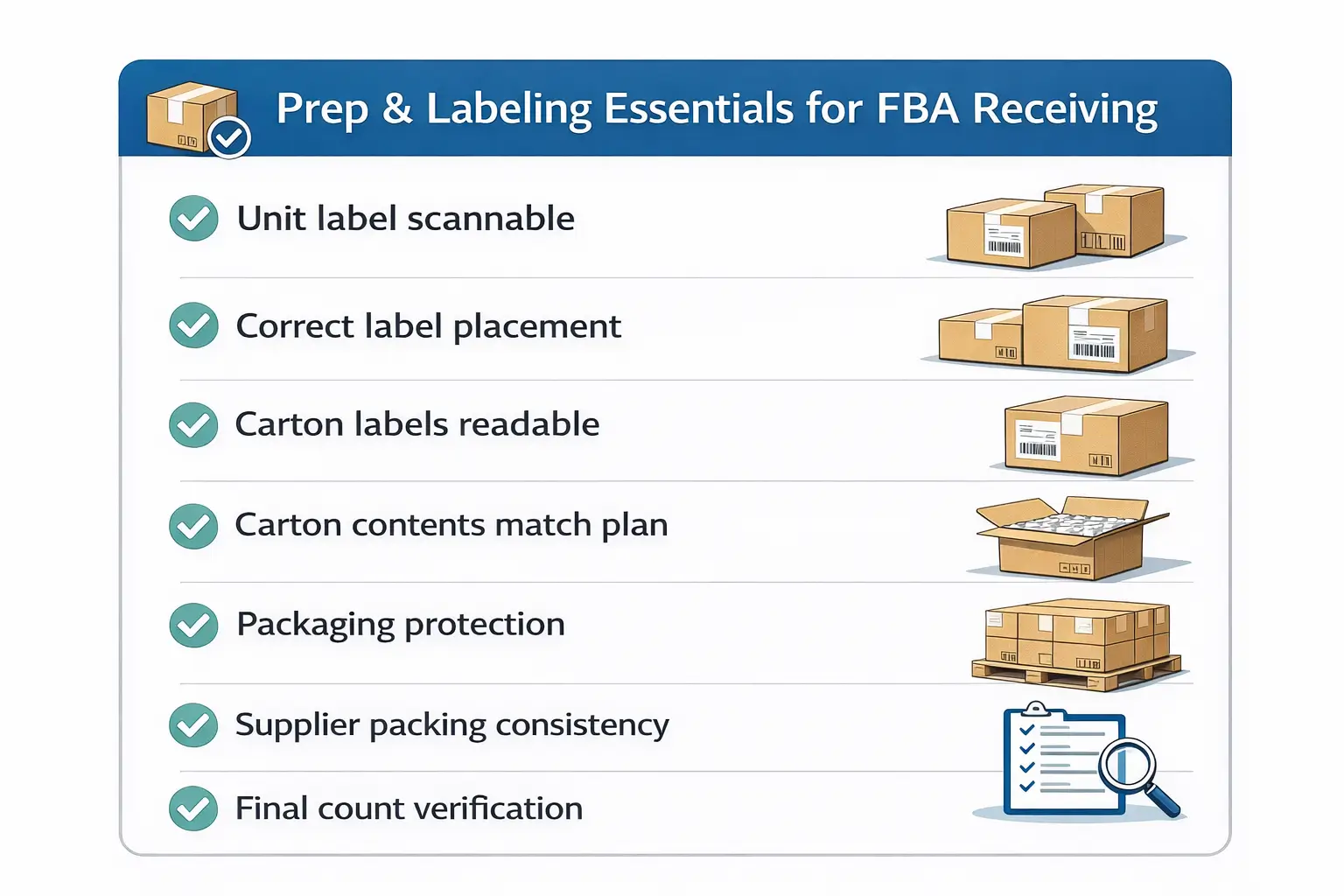
Prep & Labeling Essentials (Unit vs Carton Level — Conceptual)
Use this as a high-impact checklist to reduce inbound friction:
- Every unit needs a scannable barcode/label on the outside where it can be scanned easily: Product packaging requirements
- Labels must be consistent with your inventory plan (avoid “same SKU, different label” chaos)
- Carton labels must be readable and placed consistently (no folded edges, no tape over barcodes)
- Carton contents should match the declared plan (counts and SKUs)
- Packaging should protect the product through handling and transit (not just look good)
- Bundles/kits should be clearly configured so the unit stays intact
- Avoid mixing “quick fixes” right before shipping (late changes create mismatches)
- Confirm any routing and labeling requirements for your shipment type: Shipping and routing requirements
Boundary conditions:
- Requirements can vary by category and program settings; verify your current requirements in Seller Central.
- This checklist is conceptual by design; always align it to your shipment plan and product specifics.
A clean prep workflow also makes it easier to decide when inspection is worth the effort.
When Inspection Is Worth It (Risk-Based Scope, Not Overkill)
Inspection is typically most valuable when:
- You’re using a new supplier or a new product design
- Your product is fragile, has multiple parts, or has strict packaging needs
- Your margin is tight and defects/returns would hurt badly
- You’ve had past issues with labeling, cartons, or missing units
Keep inspection focused (don’t overcomplicate it):
- Count verification (units per carton, cartons per shipment)
- Visual defects that customers will notice
- Packaging integrity (especially corners, seals, and protection)
- Label presence and scanability
- Carton plan consistency (SKUs and quantities)
Inspection reduces risk; it does not guarantee zero problems. The goal is catching issues when fixes are cheaper.
With those controls in place, it’s easier to spot the mistakes that cost the most.
Common Inbound Mistakes (and the Fast Checks That Prevent Them)
Here are frequent mistakes that cause delays, rework, or extra costs—plus the fastest prevention checks:
| Common mistake | What it often causes | Fast prevention check |
|---|---|---|
| Unit labels missing or unscannable | Receiving delays, relabeling | Scan-check labels during prep; confirm placement rules |
| Carton labels wrong or unreadable | Delivery/receiving friction | Print clean labels; avoid tape over barcodes |
| Carton contents don’t match the plan | Discrepancies and reconciliation work | Carton plan + count verification before sealing cartons |
| Weak packaging for transit | Damage, returns, negative reviews | Drop/handling mindset test; add protection where needed |
| Late changes after the plan is set | Label and quantity mismatches | Freeze specs and carton plan before shipping |
| Multiple suppliers shipping “their own way” | Inconsistent cartons, missing units | Consolidate and standardize carton/label SOPs |
| Missing routing/labeling details | Delivery issues, rework | Confirm routing/label requirements early: Shipping and routing requirements |
| Treating fees as fixed | Profit model breaks | Recheck fee estimates in Amazon’s tools: Estimate fees and costs |
If you want Amazon’s own guidance on how certain fees vary by product attributes, Seller Central documentation can help anchor expectations: FBA fulfillment fee.
With the main workflow covered, the FAQ below answers common questions people ask when they’re deciding whether FBA is for them.
FAQ (Quick Answers to Common “Profit / Fees / Setup” Questions)
Can Amazon FBA make you rich (realistically)?
It can for some sellers, but “rich” depends on assumptions: your margin after all costs, demand, competition, ad efficiency, and your ability to execute consistently. FBA can reduce fulfillment workload, yet you still have to win on product and economics. A practical approach is to model all-in costs first, then test with a small shipment before scaling.
How much does Amazon take from a $100 sale?
There isn’t one universal number. What you pay depends on the product category and attributes (including size/weight) and the fee types that apply. A safer method is to estimate fees with your real inputs using Amazon’s tools, then add your non-Amazon costs (inbound shipping, prep, ads, returns buffer): Estimate fees and costs.
Should a beginner choose FBA or FBM?
Choose based on constraints. FBA can simplify fulfillment at scale, while FBM can offer control and flexibility. If you’re sourcing from China or juggling multiple suppliers, the deciding factor is often whether you can consistently prep, label, and ship inventory correctly without delays and rework.
What prep and labeling rules matter most?
Focus on scanability and consistency: unit barcodes/labels must be scannable, carton labels must be readable, and carton contents should match your plan. Start with Amazon’s packaging guidance and verify your settings in Seller Central: Product packaging requirements.
What mistakes cause delays or extra costs most often?
Label problems, carton content mismatches, weak packaging, and last-minute changes after inbound planning are common causes. A prevention-first process—scan-check labels, verify carton counts, standardize supplier packing, and confirm routing/label requirements—usually saves more money than “rushing faster shipping.”
Can I make $1000/month on Amazon? (Assumptions checklist)
It might be possible, but you should treat it as a math problem with assumptions: expected profit per unit after all-in costs (including inbound shipping, prep, and fees); monthly unit volume you can realistically sell (and the ad spend required); return rate and damage rate assumptions; and cash flow timing (inventory paid before it sells). If any of these assumptions are vague, use a smaller test shipment and improve the model with real data.
Bonus: How to evaluate FBA courses and income claims (without getting misled)
A good course clarifies assumptions; a hype course sells certainty. Before paying, ask:
- Are the numbers based on all-in costs (including inbound shipping, prep, ads, returns, and storage)?
- Do they explain controllables vs uncontrollables and what happens when assumptions change?
- Do they show how to estimate fees using official tools, rather than giving one universal percentage?
- Do they discuss operational failure modes (labels, cartons, receiving discrepancies), or only marketing?
With the essentials covered, the last step is turning this into an action plan you can execute.
Summary & Next Steps (A Simple Action Plan)
If you want a realistic path to your first successful FBA shipment:
- Define FBA correctly: Amazon fulfills orders, but you still own the business model.
- Build an all-in cost stack before you order inventory (include inbound shipping and prep).
- Start with a small test shipment and learn from real data (fees, ads, returns).
- Map your inbound handoffs (especially from China) and standardize cartons/labels early.
- Use prevention checklists so receiving issues don’t erase your margin.
If you’re preparing your first shipment from China—or consolidating multiple suppliers—having a clear prep and inbound workflow can reduce avoidable delays and rework. FBABEE provides China-side consolidation, inspection, and FBA prep support for Amazon-bound shipments. Visit https://fbabee.com/ to see the service overview.