

Shipping from China to Amazon FBA in the USA rarely has one fixed price. Two sellers can ship similar products and still receive different quotes because carton size, weight, shipping method, delivery scope, Amazon requirements, and quote structure all change the final number.
For that reason, sellers should ask more than “How much does shipping cost?” They should also ask, “What details do I need before I compare quotes?” A low quote may exclude the same delivery point, duty scope, Amazon labeling support, or weight calculation that another provider includes.
How much does Amazon FBA shipping cost from China to the USA?
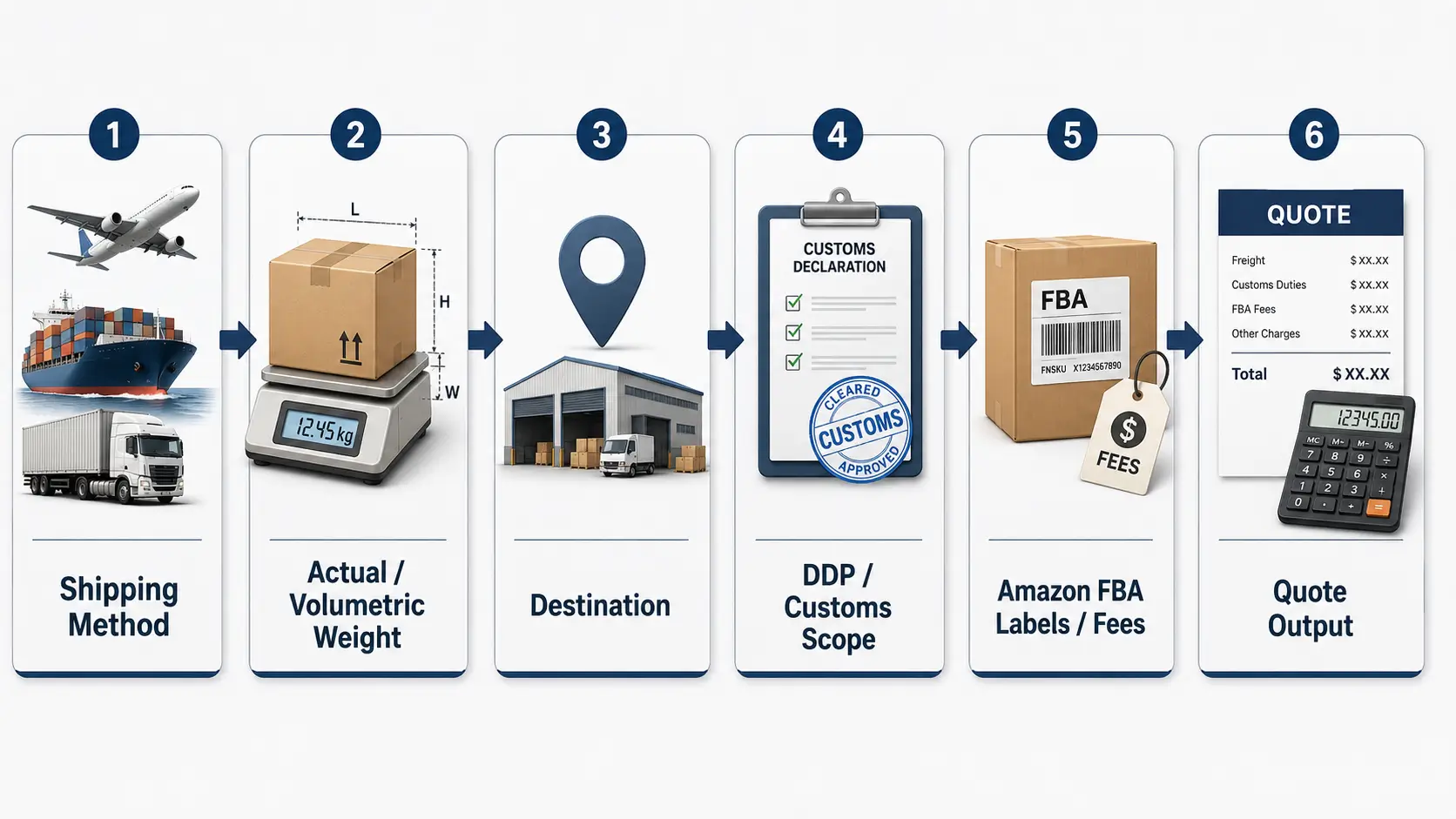
Amazon FBA shipping cost from China to the USA has no single fixed price. Instead, your quote depends on shipping method, actual or volumetric weight, cargo volume, destination, DDP or customs scope, Amazon FBA labeling and routing needs, and timing. For a reliable quote, prepare carton dimensions, gross weight, product details, destination, and expected service scope.
What affects Amazon FBA shipping cost from China to the USA?
Several factors shape a shipping quote. Weight matters, but it does not tell the whole story. In addition, carton dimensions, delivery location, Amazon-side fees, and DDP or customs scope can change the quote.
Main cost drivers to check first
Start with the variables below before you request a price. Then, when you compare quotes, check whether each provider used the same shipment data and the same delivery scope.
| Cost factor | Why it matters | What to prepare | Boundary |
|---|---|---|---|
| Shipping method | Ocean, air, express, DDP, supplier shipping, and Amazon logistics follow different pricing logic. | Preferred method, urgency, cargo volume, and budget range. | Do not assume one method is always cheapest or fastest. |
| Shipment weight and volume | Large but lightweight cartons may trigger dimensional or volumetric billing. | Carton length, width, height, carton count, and gross weight. | Carrier formulas can vary. |
| Destination | Delivery to a port, warehouse, prep center, or Amazon fulfillment center changes the scope. | Amazon destination, warehouse address, ZIP code, or routing plan. | Compare quotes only when they use the same delivery point. |
| Product type | Some goods need extra handling, documents, inspection, or restrictions review. | Product name, material, HS code if available, and battery/liquid/magnetic status if relevant. | Do not treat all products as equal shipping risk. |
| DDP or customs scope | Duties, taxes, importer role, customs clearance, and delivery point can change total cost. | Incoterms, importer details, tax/duty expectations, and quote inclusions. | Confirm the scope in writing and avoid legal assumptions. |
| Amazon FBA requirements | Labels, packaging, box IDs, and Amazon routing can add preparation work. | Seller Central shipment plan, labels, prep requirements, and carton data. | Always check current Seller Central instructions. |
Shipment size, weight, and carton dimensions
For many air and express shipments, carriers do not look at scale weight alone. DHL explains that carriers compare actual weight and volumetric weight, then base chargeable weight on the larger figure. As a result, a bulky lightweight carton can receive a higher quote than a seller expects.
Before asking for a quote, prepare the number of cartons, gross weight per carton, carton length, carton width, carton height, total CBM if available, product name, packaging type, and whether the cartons already meet Amazon-ready requirements.
In short, do not estimate with product weight alone. Once a forwarder receives carton dimensions, the quote may change.
Destination, Amazon requirements, and service scope
China-to-USA Amazon FBA shipping includes more than international freight in many cases. The shipment may move from a factory to a port or airport, clear export and import steps, go to a prep center or Amazon fulfillment center, and follow Amazon shipment rules.
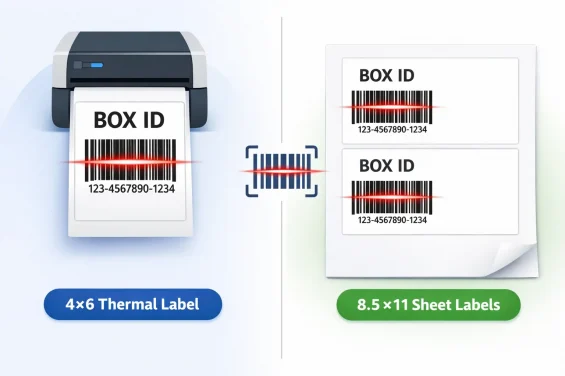
For example, Amazon Seller Central says small-parcel boxes need an FBA box ID label and a carrier label. In addition, Amazon’s routing requirements say each box in a shipment needs an Amazon FBA Box ID label in addition to carrier labels. Therefore, labeling and shipment-plan accuracy should sit inside the logistics discussion.
Also, sellers should separate international freight from Amazon-side costs. Amazon’s inbound placement service fee uses factors such as product size tier, shipping weight, and inbound locations. So, check the current Seller Central fee context before you mix Amazon-side fees into a freight quote.
Sea freight vs air freight vs express vs DDP vs Amazon logistics
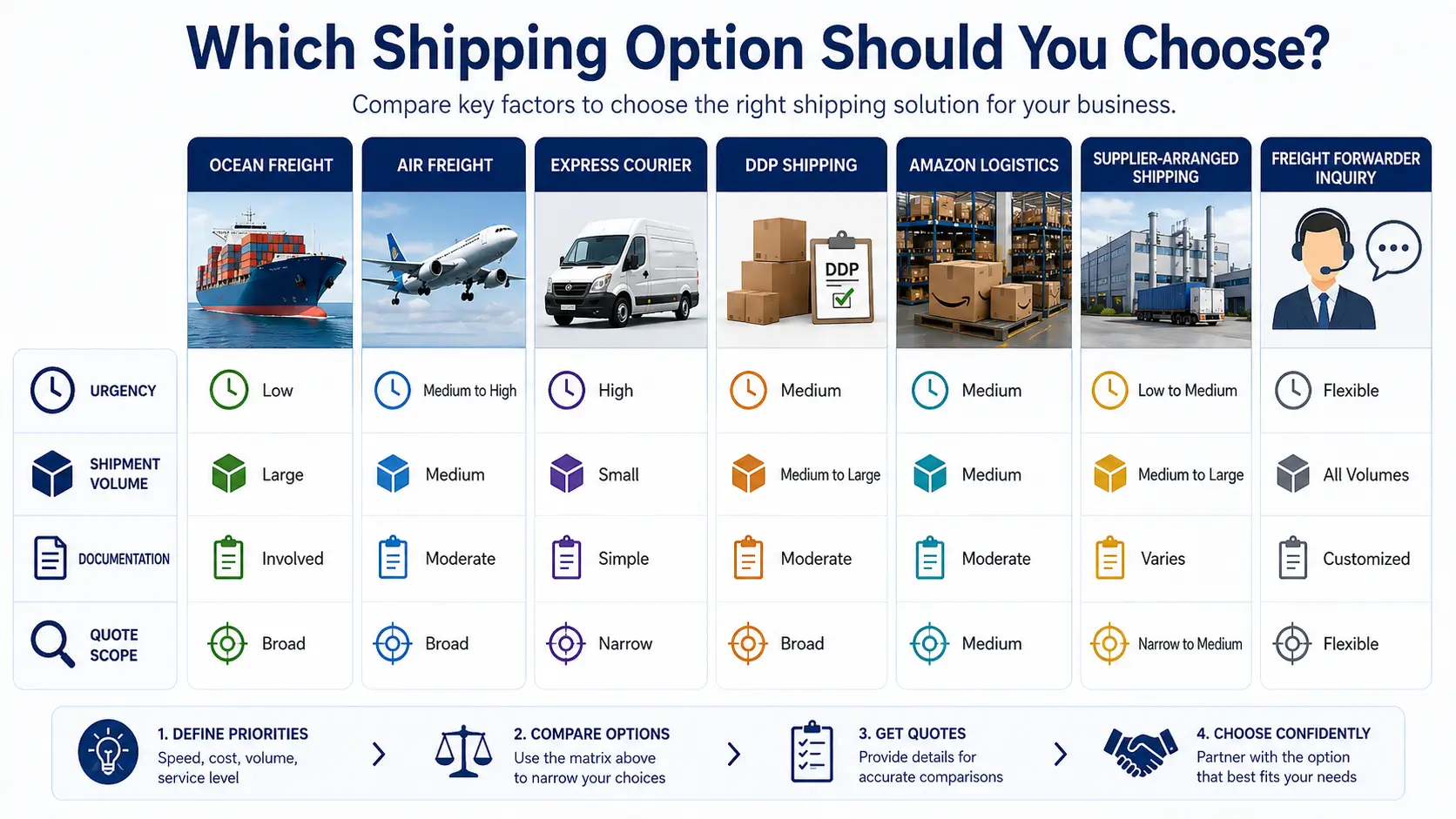
No single shipping method fits every FBA shipment. Instead, the right quote path depends on urgency, shipment size, cash flow, and the level of service support the seller needs.
Compare the main quote paths
The table below gives a safe comparison framework. However, it does not replace a live quote because route, cargo details, and service scope still matter.
| Method / path | Better fit | Watch-outs | What to confirm |
|---|---|---|---|
| Ocean freight | Larger shipments where cost control matters more than speed. | Slower movement, port handling, destination delivery, and inventory planning. | Total route, destination, delivery scope, and Amazon receiving plan. |
| Air freight | Smaller or urgent shipments where speed matters. | Chargeable weight can make bulky goods expensive. | Actual vs volumetric weight and delivery point. |
| Express courier | Samples, small cartons, urgent replenishment, or lightweight goods. | Cost can rise quickly as weight or carton size increases. | Product restrictions, weight calculation, and delivery address. |
| DDP shipping | Sellers who want the quote to cover more destination-side responsibility. | “DDP” wording can hide different provider assumptions. | Duties, taxes, importer role, delivery point, exclusions, and documents in writing. |
| Amazon Global Logistics | Eligible sellers comparing an Amazon-managed freight option. | Eligibility, lane, service scope, and Seller Central setup need confirmation. | Current Amazon program details. |
| Supplier-arranged shipping | First-time or small sellers who rely on factory support. | The quote may not separate freight, duties, prep, and Amazon delivery details. | What the supplier includes and where responsibility transfers. |
| Freight forwarder inquiry | Sellers comparing service scope, routing, and quote details. | Quotes only compare fairly when inputs and scope match. | Carton data, destination, product details, and incoterms. |
Amazon-managed options can also enter the comparison. Amazon says its Global Logistics program can ship ocean cargo or air freight from China directly to Amazon fulfillment networks in the US and other regions. In addition, Amazon SEND supports global inventory shipping by air or ocean between supported countries.
However, those program pages do not prove that every seller should use an Amazon-managed program. They also do not prove that any third-party provider has an Amazon partnership. They simply give sellers another option to compare.
When ocean freight may fit
Ocean freight may fit larger shipments when the seller can plan inventory earlier. Because this method usually needs more planning time, sellers should compare cost control against cash-flow timing and replenishment risk.
Before choosing ocean freight, confirm the delivery scope. A quote to a US port does not equal a quote delivered to an Amazon fulfillment center. Likewise, a quote that excludes destination charges does not equal one that includes final delivery.
When air or express may fit
Air freight or express may fit urgent replenishment, smaller shipments, high-value products, or samples. However, bulky or low-density products may cost more because volumetric or dimensional weight can drive the quote.
Therefore, sellers comparing air quotes should not ask only for a price per kilogram. They should also ask how the provider calculates chargeable weight and whether the quote uses actual weight, volumetric weight, or another billing rule.
Where Amazon Global Logistics fits
Amazon Global Logistics may fit eligible sellers who want to manage international freight inside Amazon’s ecosystem. Still, sellers should compare it with supplier-arranged shipping and third-party forwarding by service scope, visibility, total cost components, and operational control.
For a fair comparison, check what origin services the quote includes, whether it covers export and destination handling, how it handles customs and duties, whether it delivers to Amazon or another location, how it manages labels and routing, and which fees sit outside the freight quote.
What does DDP mean for Amazon FBA shipping?
DDP stands for Delivered Duty Paid. ICC Academy explains that under DDP, the seller delivers goods to the agreed destination, handles export, transit, and import clearance formalities, and takes on major responsibility for risks and costs until the agreed delivery point.
Confirm the DDP quote scope
For Amazon FBA sellers, the term “DDP” does not answer every question. Instead, the exact quote scope matters. Use the table below to confirm the details before you compare a DDP quote with another shipping option.
| DDP item | May be included | Must confirm | Do not assume |
|---|---|---|---|
| Export handling | Often appears in a DDP-style quote. | Who handles export documents and pickup. | That every origin charge appears in the price. |
| International freight | Usually forms part of the quote. | Shipping method, route, and billing weight. | That the provider guarantees transit timing. |
| Import duties and taxes | Providers often discuss these under DDP. | Product classification, importer role, duty/tax treatment, and exclusions. | That every product has the same duty outcome. |
| Customs clearance | The quote may include it. | Who acts as importer or record holder where relevant. | That anyone can guarantee clearance. |
| Final delivery | The provider may deliver to Amazon, a prep center, or another destination. | Exact delivery address and receiving requirements. | That delivery to port equals delivery to FBA. |
| Amazon prep and labels | Some providers include this service, while others do not. | Labeling, box ID labels, packaging, palletization, and appointment scope. | That “DDP” automatically includes Amazon prep. |
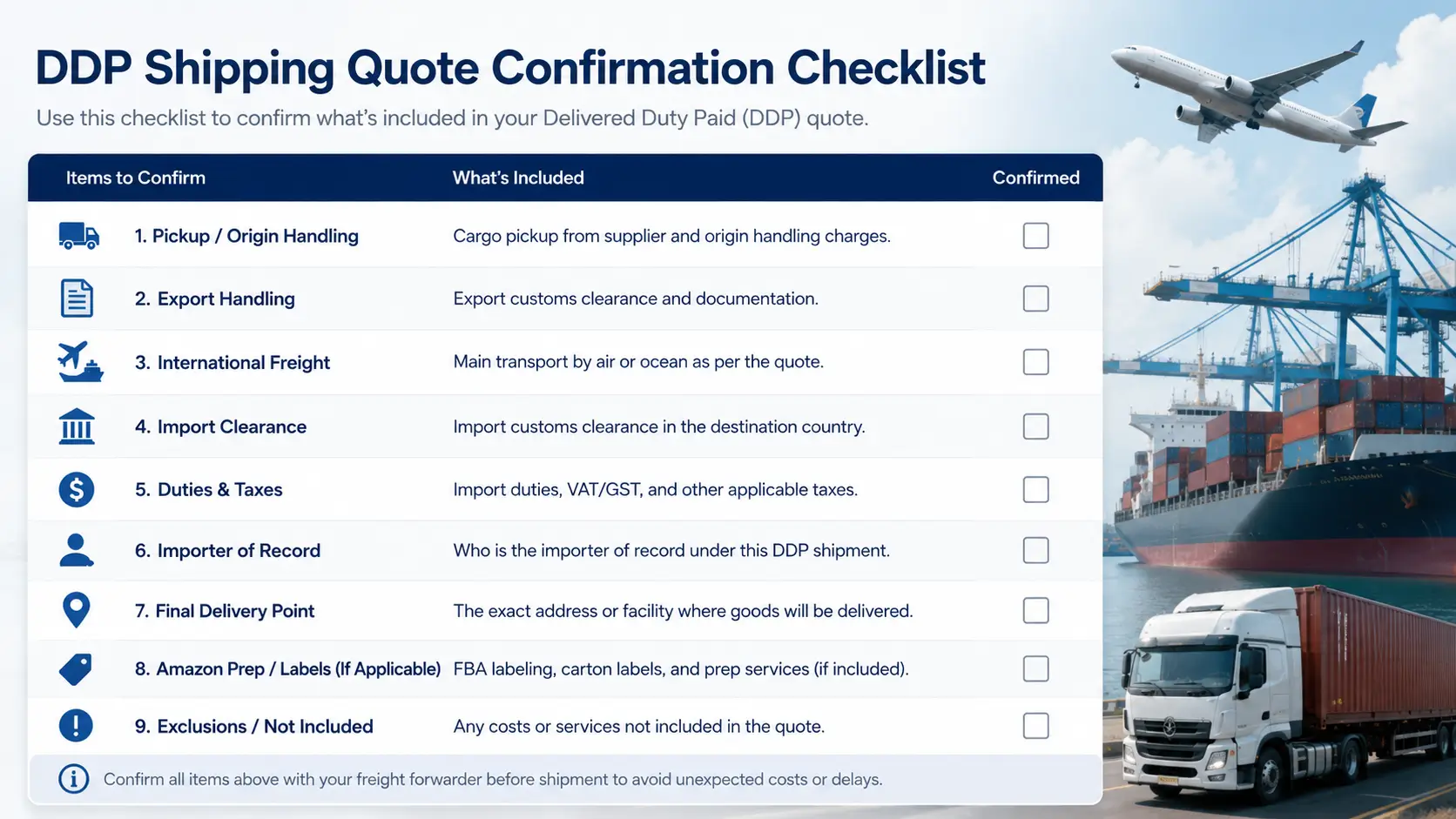
For clarity, ask the provider to confirm whether the quote includes pickup, export handling, international freight, import clearance, duties or taxes, final delivery to the named Amazon destination, Amazon labeling or prep support, and any exclusions. This detailed question works better than asking only, “Is this DDP?”
What information do you need for an accurate quote?
A useful quote starts with useful inputs. If a seller sends only product name and quantity, the provider can give only a rough estimate. However, when the seller sends carton dimensions, gross weight, destination, product type, and service expectations, each provider can quote the shipment more fairly.
Quote details to prepare
Use the checklist below before you request or compare a China-to-USA Amazon FBA shipping quote. As a result, you can reduce rework and spot missing scope items faster.
| Quote input | What to provide | Why it matters |
|---|---|---|
| Product name | Clear product description. | Helps identify handling or restriction questions. |
| Product category/material | Battery, liquid, magnetic, textile, food-contact, or regulated attributes if relevant. | Some products need additional review. |
| Carton count | Number of cartons or pallets. | Affects handling and quote structure. |
| Carton dimensions | Length × width × height for each carton type. | Supports volumetric or chargeable weight checks. |
| Gross weight | Weight per carton and total shipment weight. | Supports freight calculation. |
| Total CBM | Cubic meters if available. | Helps with ocean freight comparison. |
| Origin address | Factory, supplier warehouse, port, or airport. | Changes pickup and origin handling. |
| Destination | Amazon fulfillment center, prep center, warehouse, or ZIP code. | Changes final delivery scope. |
| Incoterms/service scope | EXW, FOB, DDP, or another agreed structure. | Defines who handles each cost and responsibility. |
| Amazon requirements | Labels, box IDs, packaging, palletization, appointment needs. | Helps avoid receiving and routing problems. |
| Timing need | Target delivery or replenishment window. | Helps providers compare routing options without promising fixed transit time. |
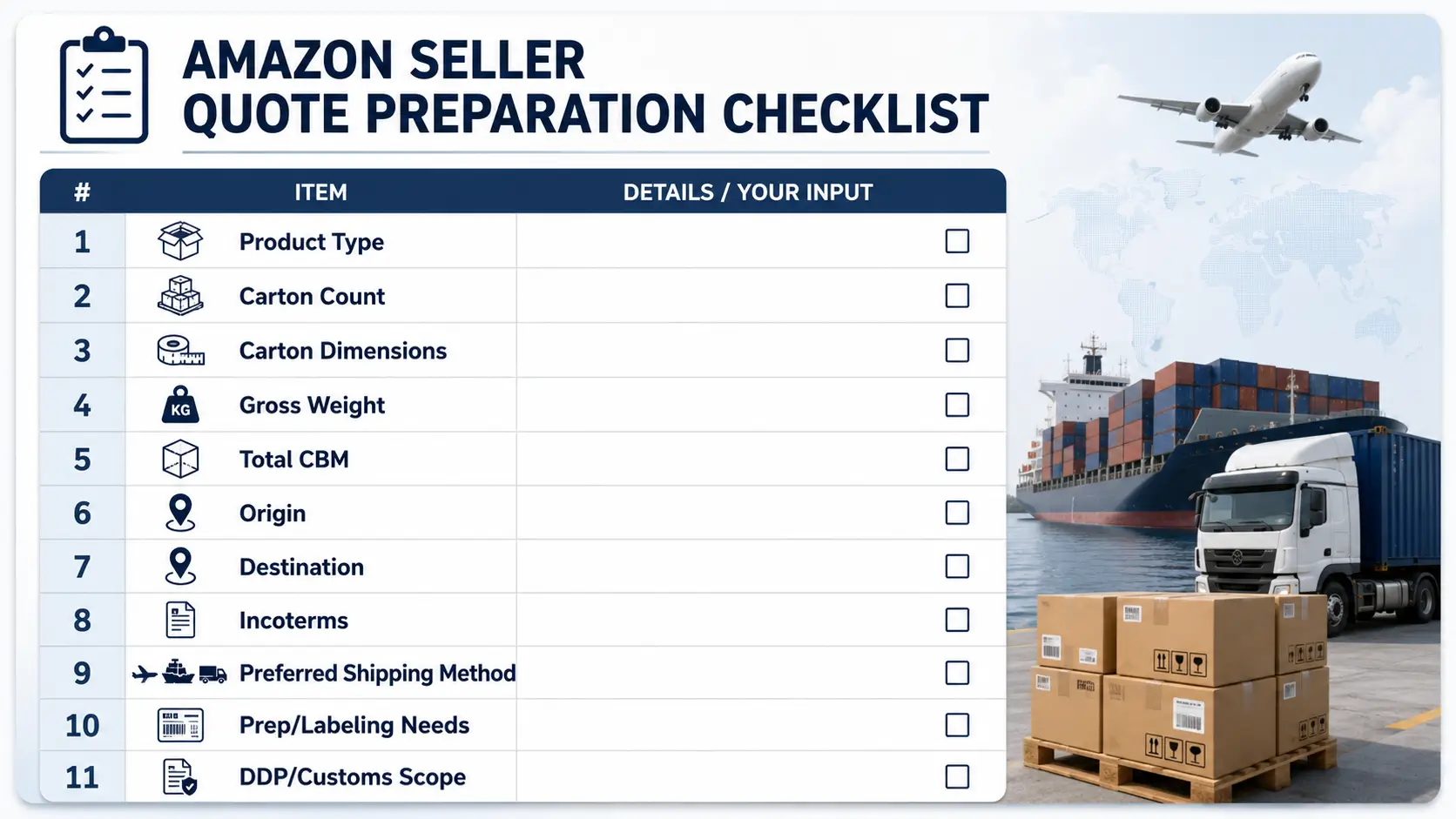
Finally, send the same details to every provider. Then you can compare shipment, destination, and service scope on the same basis.
Common mistakes when comparing FBA shipping quotes
Many quote problems start when sellers compare prices without comparing scope. Therefore, review the five mistakes below before you choose a shipping path.
Mistake 1: Comparing quotes with different delivery points
One quote may cover delivery to a port. Another may cover delivery to an Amazon fulfillment center. A third may include prep center handling. These are different services.
Ask: “What final delivery point does this quote include?”
Mistake 2: Ignoring chargeable weight
A quote based on actual weight may change after the provider adds carton dimensions. This point matters most for air and express shipments.
Ask: “Does this quote use actual weight, volumetric weight, or chargeable weight?”
Mistake 3: Treating DDP as a complete answer
DDP helps describe responsibility, but it does not replace written quote details. The quote should still clarify duty or tax handling, importer role, final delivery point, exclusions, and Amazon prep.
Ask: “What exactly does this DDP quote include and exclude?”
Mistake 4: Mixing freight cost with Amazon-side fees
International freight forms only one part of Amazon seller economics. In addition, Amazon-side fees, placement decisions, storage, fulfillment fees, and prep or labeling needs require separate checks in Seller Central.
Ask: “Which costs are freight costs, and which costs are Amazon-side costs?”
Mistake 5: Choosing the lowest quote without checking scope
A lower quote may exclude destination handling, customs-related costs, appointment delivery, palletization, or Amazon prep. As a result, the cheapest visible number can become more expensive later.
Ask: “Can you provide a line-by-line scope before I compare this quote?”
FAQ
How much does Amazon FBA shipping cost from China to the USA?
There is no single fixed cost. Instead, the quote depends on shipping method, shipment weight and volume, carton dimensions, destination, service scope, DDP or customs handling, Amazon FBA requirements, and timing. Use current quotes rather than old rate tables when you make a buying decision.
What affects China-to-US FBA shipping cost the most?
The largest drivers usually include shipping method, cargo volume, chargeable weight, destination, delivery scope, and whether the quote includes duties, taxes, customs handling, Amazon prep, or final delivery to an Amazon fulfillment center.
Is sea freight or air freight better for Amazon FBA?
Neither method works best for every shipment. Ocean freight may fit larger planned shipments when timing is less urgent. Air freight or express may fit urgent or smaller shipments, but carton size and chargeable weight can increase cost. Therefore, compare shipment size, replenishment risk, cash flow, and delivery scope.
What does DDP shipping include for Amazon FBA?
DDP may include more seller-side responsibility for freight, import clearance, duties, taxes, and delivery to a named destination. However, Amazon FBA sellers should not rely on the term alone. Confirm the delivery point, duties and taxes, importer role, Amazon prep or labeling, and exclusions in writing.
Why do forwarders charge by dimensional or volumetric weight?
Carriers account for both weight and space. For example, a large lightweight carton may take more aircraft, truck, or warehouse space than its scale weight suggests. For air and many express shipments, providers may quote chargeable weight based on actual or volumetric weight.
Can a China supplier ship directly to Amazon FBA?
In many workflows, inventory can move from a China supplier toward Amazon FBA. However, the shipment still needs correct Amazon shipment setup, labels, packaging, routing, customs handling, and delivery scope. The seller should confirm the supplier’s role and decide whether a forwarder or prep service is also needed.
Should I use Amazon Global Logistics or a freight forwarder?
Compare them by eligibility, route, service scope, visibility, customs or DDP needs, quote structure, and support level. Amazon Global Logistics gives eligible sellers an Amazon-managed option. Meanwhile, third-party forwarders or supplier-arranged shipping may offer different service scopes.
What information is needed for an accurate FBA shipping quote?
Prepare product details, carton count, carton dimensions, gross weight, total CBM if available, origin, destination, Amazon shipment requirements, preferred method, incoterms or DDP scope, and any prep or labeling needs.
Prepare your shipment details before requesting a quote
Before you ask for a China-to-USA Amazon FBA shipping quote, prepare the shipment details first. At minimum, collect product type, carton count, carton dimensions, gross weight, origin, destination, preferred shipping method, incoterms or DDP expectations, and Amazon prep or labeling requirements.
With complete shipment data, you can compare quotes more easily, revise details faster, and reduce surprises later.
Source checks used for this guide
External link note: These links support official or technical context only. They do not prove FBABEE service capability.