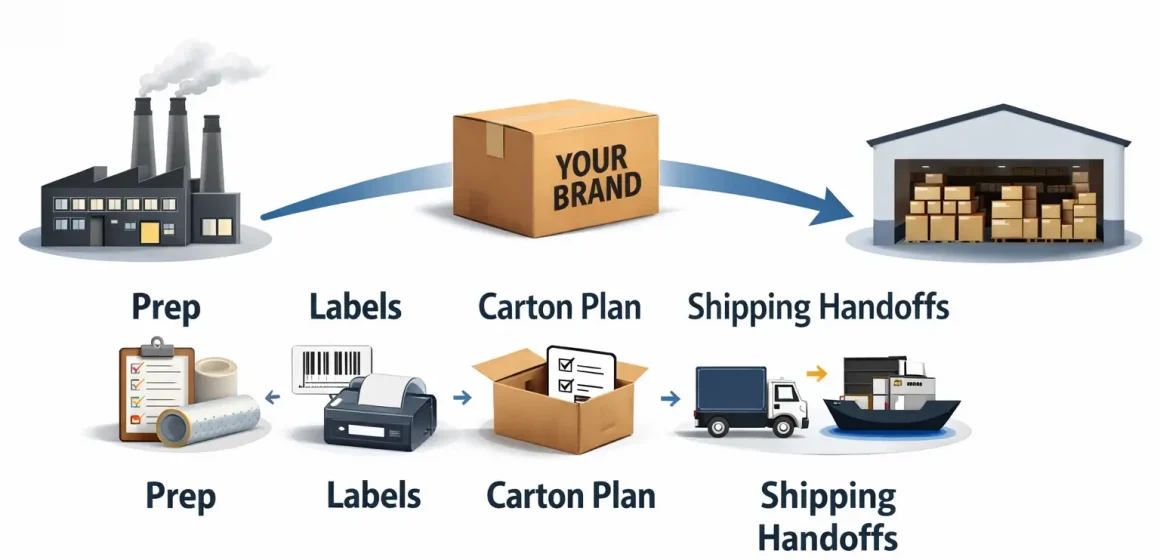
Private label + FBA is a popular way to build a brand on Amazon—if you understand the “middle steps” between your supplier and Amazon’s warehouses.
If you only read one section, start here. An Amazon FBA private label business is when you sell products under your own brand while Amazon fulfills customer orders after your inventory is checked into Amazon’s network.
Definition (private label + FBA): You own the brand (name, packaging, listing), a manufacturer makes the product, and Amazon FBA fulfills orders after inventory arrives and is received.
Amazon FBA typically handles (after check-in):
You (the seller/brand owner) still handle:
Now that the baseline is clear, “private label” means you’re selling under your brand name rather than reselling someone else’s brand. You work with a manufacturer, then you control how the product is packaged, positioned, and listed.
Quick clarity:
With the model defined, it helps to compare private label to two common resale approaches. Private label is the “build a brand” path; wholesale and arbitrage are resale models that are often faster to start but give you less control.
Boundary conditions:
Once you choose private label, the biggest clarity win is this: FBA is fulfillment, not sourcing and not shipping from your factory. Amazon describes FBA as a program where you send products to Amazon’s fulfillment centers and Amazon then stores, picks, packs, ships, and handles customer service and returns for those orders.
Amazon FBA handles (mostly after inventory is received):
You still need to handle (before and around check-in):
Two “depends on” notes:
With responsibilities clear, the private label workflow is basically: validate → source → brand → inbound → launch.
After you’ve “started the business,” the part that breaks most first shipments is operational. Getting compliant inventory from your supplier(s) into Amazon’s network is where most avoidable mistakes happen.
We start with the simplest case. If you buy from one factory and one main SKU, keep the workflow linear.
Boundary condition:
When you add more suppliers, handoffs multiply. Consolidation helps you standardize prep and carton planning in one place.
Why it helps (without overpromising): fewer handoffs usually means fewer places for preventable mistakes.
After you map the flow, shipping mode is the key trade-off decision. In general:
“Depends on” variables: shipment size/weight, urgency, seasonal deadlines, product value, and how much buffer you have.
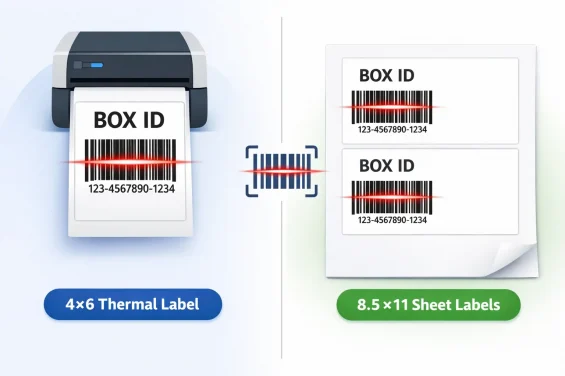
Once the inbound flow is clear, preventable receiving problems often come down to labels, cartons, and packaging. A pre-flight checklist catches issues before the shipment leaves your control.
Two US-store notes:
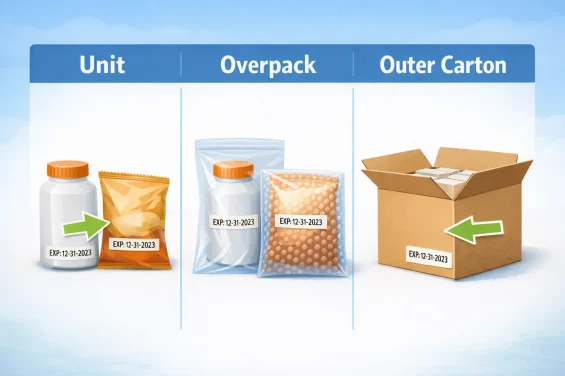
Start at the unit level. If the unit label is wrong or unreadable, everything else becomes harder.
Pre-flight checks:
Once labels and cartons are right, packaging is the next lever. Packaging issues show up late—often after the shipment is already in motion.
Finally, protect the handoff. Handoffs are where “we thought you did it” becomes a costly surprise.
If the checklist above feels hard to execute consistently, outsourcing can reduce coordination load—especially for multi-supplier shipments. The point is to add checkpoints and repeatability, not to expect “no problems ever.”
If complexity is rising, a quick fit check helps. Outsourcing is often a fit if:
Once outsourcing seems reasonable, good inputs and good questions prevent surprises. Start by preparing:
Ask:
If you’re sourcing from China and want help with consolidation, inspection checkpoints, FBA prep (labels/packaging), and coordinating door-to-door delivery to Amazon or your warehouse, a specialist partner can take ownership of the “factory → FBA” middle step. FBABEE focuses on China-side consolidation + FBA-ready prep and shipping coordination for sellers who want a more repeatable inbound SOP.
Once you’re operational, the goal is not “zero risk.” Building checkpoints helps you catch mistakes early.
After you understand the workflow and risks, budgeting becomes clearer. Costs vary widely—but you can plan by buckets and the variables that move them.
Common cost buckets:
Variables that change the total: size/weight, order quantity, shipping mode, supplier count, and prep complexity.
A safer way to start: run a smaller test order, validate your inbound SOP, then scale restocks once the process is stable.
Q: What is an Amazon FBA private label business? A: It’s a model where you sell a product under your own brand, and Amazon FBA fulfills customer orders after your inventory is shipped to and received in Amazon’s fulfillment network. You still own the product, listing, and inbound preparation responsibilities.
Q: Is “Amazon private label” the same as Amazon’s own brands? A: No. “Private label” describes selling under a brand owned by the seller. Amazon also owns brands, but that’s separate from third-party sellers building their own private-label brands on the marketplace.
Q: What does Amazon FBA do, and what does the seller still have to do? A: Amazon describes FBA as storing inventory and handling pick/pack/ship plus customer service and returns for FBA orders. Sellers still need to source products, create listings, and send properly prepped and labeled inventory into Amazon’s network.
Q: Private label vs wholesale vs arbitrage — what’s the difference? A: Private label means you control a seller-owned brand and product experience. Wholesale and arbitrage are resale models where you sell existing brands with less listing control and fewer branding levers. Private label typically requires more upfront work but gives more control.
Q: What are the main steps to start a private label product with FBA? A: Most sellers follow: validate product → sample → source supplier → decide differentiation → build listing assets → plan prep/inbound → create “Send to Amazon” shipment → launch and iterate. The exact order can vary by product type and compliance needs.
Q: What prep and labeling problems most often cause delays at FBA receiving? A: Common issues include unreadable or incorrect unit labels, carton labels that don’t match the shipment plan, and packaging that isn’t “storage ready.” Check scannability and placement before shipping.
Q: When should you use a prep center or freight forwarder for private label? A: Consider outsourcing when you have multiple suppliers, bundles/kits, many SKUs, or limited bandwidth to run consistent pre-flight checks. A good partner adds checkpoints and documentation—not guarantees—so you can run a repeatable inbound process.
Q: How much money do you need to start Amazon FBA private label? A: Costs vary widely, so plan by buckets: samples, inventory, packaging/labels, inbound logistics and prep, Amazon fees, and marketing. The biggest drivers are product size/weight, order quantity, shipping mode, supplier count, and prep complexity. Starting with a smaller test order can reduce risk before scaling.
To turn this into action, focus on repeatability. Private label + FBA works best when you treat inbound operations like a system, not a one-time shipment.
Back to top ↑
Your email address will not be published. Required fields are marked *
Comment *
Name *
Email *
Save my name, email, and website in this browser for the next time I comment.
Δ
This site uses Akismet to reduce spam. Learn how your comment data is processed.
Table of Contents Heavy box label decision + placement Terms that get mixed up: Team Lift vs Heavy Package vs ...
Table of Contents Amazon FBA shipment label size (4×6 vs 8.5×11) + the 10-second label sanity check Which label are ...
Table of Contents Not the same thing: expiration date labels vs FBA shipping labels FBA expiration date labeling in 60 ...