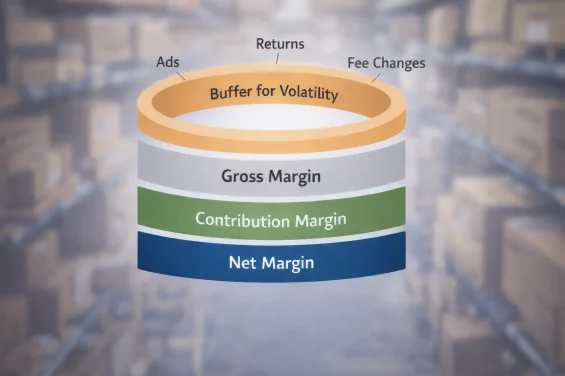
If you’ve ever heard “you need 100% ROI on Amazon,” you’re not alone—and it’s also why many sellers end up making decisions based on incomplete math. A “good ROI” depends on what you count as the investment (buy cost vs total landed cost), whether your numbers include PPC and returns, and how fast your inventory sells through.
This guide gives you practical ROI benchmark bands, a clear calculation method, and a cost checklist that prevents inflated (“fake”) ROI—especially helpful if you source from China and have prep/inbound shipping costs that vary by shipment.
A “good” Amazon FBA ROI is usually expressed in bands, not a single universal number—because ROI changes a lot depending on whether you calculate it on buy cost or on total landed cost, and whether you include PPC and returns.
Key points
ROI measures how much net profit you earn relative to what you had to invest to sell the unit. For Amazon FBA, the key is defining the investment base consistently—otherwise two sellers can report wildly different ROI on the same SKU.
ROI % = (Net profit ÷ Investment base) × 100
Step-by-step: how to calculate ROI for an FBA SKU
Boundary conditions / caveats
A practical way to avoid confusion is to decide whether you’re doing a quick screening calculation or a decision-grade landed-cost calculation.
“For every dollar I invest in this unit, how much profit do I get back?” The tricky part is that the “invest” side can mean different things—so you need to pick a definition and stick with it when you evaluate products and restocks.
Buy-cost ROI is useful for quick screening, but landed-cost ROI is usually better for real go/no-go decisions—especially when inbound shipping and prep costs are meaningful.
ROI calculations go wrong when net profit is missing a major cost bucket. Use a “bucket sanity check” before trusting the percentage.
Steps
Quick sanity check
To calculate Amazon FBA ROI accurately, include every cost that changes net profit and every cost that represents real cash outlay to get inventory sold—then treat uncertain costs (PPC, returns, inbound/prep) as assumptions you can stress-test.
Grouped cost checklist (decision-grade)
Cost categories table (quick scan)
If you’re unsure where most ROI mistakes happen, a good approach is to identify the 2–3 inputs you’re least confident about (often PPC, returns, and inbound/prep) and model ROI as a range.
The most common “ROI inflation” comes from leaving out variable costs and landed costs—especially PPC, returns, storage risk, and inbound/prep.
Most frequently missed items:
A simple rule: if the cost affects your real cash profit or cash outlay, it belongs in the ROI model.
When you don’t know PPC or returns yet, treat ROI as a range and decide based on the conservative case—not the best case.
If you’d like to avoid metric confusion entirely, it helps to separate ROI from profit margin and markup and use each metric for the decision it’s best at.
ROI, profit margin, and markup can all describe profitability, but they answer different questions because they use different denominators. Using the wrong one can lead to bad sourcing or pricing decisions.
To make ROI actionable, many sellers also set a minimum ROI threshold—then raise it when risks (PPC volatility, returns, lead times) increase.
A minimum ROI is a risk-managed threshold, not a universal number. Your minimum should rise when uncertainty and cash lock-up risk rise—and some red flags can override a “good-looking” ROI entirely.
Decision checklist: when to raise your minimum ROI
Common mistakes that inflate ROI (and how to fix them)
A final reality check is that ROI doesn’t account for time—so sell-through speed can change what “good ROI” means in practice.
ROI doesn’t include the time your cash is tied up. A product with lower ROI that sells fast can outperform a higher-ROI product that sells slowly because your capital turns over more often.
If you want to translate your model into something you can use every day, calculators can help—provided you enter decision-grade inputs.
FBA calculators are useful for estimating profitability, but they’re only as accurate as your inputs. The goal is to feed the calculator a cost-complete model—especially for PPC, returns, and landed costs (prep + inbound shipping).
A practical calculator workflow
Common input mistakes
How to estimate prep and inbound per unit (range-based)
If you prefer not to manage these estimates alone, a logistics and prep partner can help you standardize landed-cost inputs before you commit to an MOQ.
Need help estimating landed cost for a China-sourced FBA shipment (including consolidation, prep, and inbound shipping allocation)? FBABEE can help you map the workflow and produce decision-grade per-unit estimates so your ROI model reflects real costs. Learn more at https://fbabee.com/
Different Amazon business models tolerate different ROI targets because the risk, overhead, and control differ. Use this as directional guidance rather than a fixed numeric rule.
If ROI is not where you want it, there are usually a few levers that move the number—without changing the core math.
ROI improves when you increase net profit per unit or reduce your true cash outlay per unit. Focus on levers that are controllable and measurable.
High-impact levers
It depends. Around 30% ROI can be workable when sell-through is fast and PPC/returns are stable, but it’s often risky if your ad costs are uncertain or your lead time is long.
Both exist, but they serve different purposes. Buy-cost ROI is a quick screening metric; landed-cost ROI is usually the better basis for launch and restock decisions.
Yes—if you expect to use ads, PPC should be included in net profit (often as a per-unit assumption). Ignoring PPC is one of the fastest ways to overstate ROI.
ROI compares profit to your investment base (cost/investment), while profit margin compares profit to revenue (selling price). ROI is often best for sourcing decisions; margin is often best for pricing health and long-term sustainability.
Returns reduce net profit and can introduce extra operational costs, so they can materially reduce ROI—especially when your margins are thin.
The most common mistakes are missing costs and inconsistent denominators.
Because ROI doesn’t account for time. Fast sell-through helps you recycle capital and reduces aging risk; slow sell-through increases storage risk and often requires a higher minimum ROI to compensate for uncertainty and cash lock-up.
Key takeaways
Practical next steps before you launch or restock
Useful tools and pages
If you’re preparing a first China-to-FBA shipment or coordinating multiple suppliers, getting a clean landed-cost estimate (COGS + prep + inbound allocation) can make your ROI decision much safer. FBABEE supports consolidation, prep, and door-to-door shipping to FBA so your ROI model can be built on decision-grade inputs. https://fbabee.com/
Back to top
Your email address will not be published. Required fields are marked *
Comment *
Name *
Email *
Save my name, email, and website in this browser for the next time I comment.
Δ
This site uses Akismet to reduce spam. Learn how your comment data is processed.
Table of Contents Amazon FBA + Profit Reality Check (No Hype) What Is Amazon FBA? (Plain-English Definition + Who Does ...
Table of Contents What Amazon Account Level Reserve Is (and why your payout looks lower) Account Level Reserve basics: meaning, ...
If you’ve ever asked “What’s a good Amazon FBA profit margin?” you’re not alone—and you’ve probably noticed that most answers ...