
Table of contents
Fast Answer: Amazon FBA vs Shopify — which is “better” depends on your constraints
Amazon and Shopify aren’t identical choices: Amazon is a marketplace, and FBA is a fulfillment service inside Amazon’s ecosystem; Shopify is a store platform where you run your own site and drive your own traffic. So the “better” option depends on what you need most right now: demand access, brand control, or operational simplicity.
A quick “better when…” selector:
- Amazon FBA is often better if you want built-in shopper demand, you’re validating products quickly, and you’d rather outsource fulfillment operations.
- Shopify is often better if you want maximum brand control, you want to build repeat purchase/retention, and you can drive traffic through marketing channels.
- Using both can be better if you want diversification and can handle added complexity (inventory planning, returns ownership, and customer support boundaries).
Important boundaries:
- There’s no universal winner—and this article avoids fee/profit “math” because it varies by category, marketing mix, and operations.
- You’re choosing multiple layers: where you sell, how you fulfill, and how customers find you.
The 3-layer model most people miss: channel vs fulfillment vs traffic
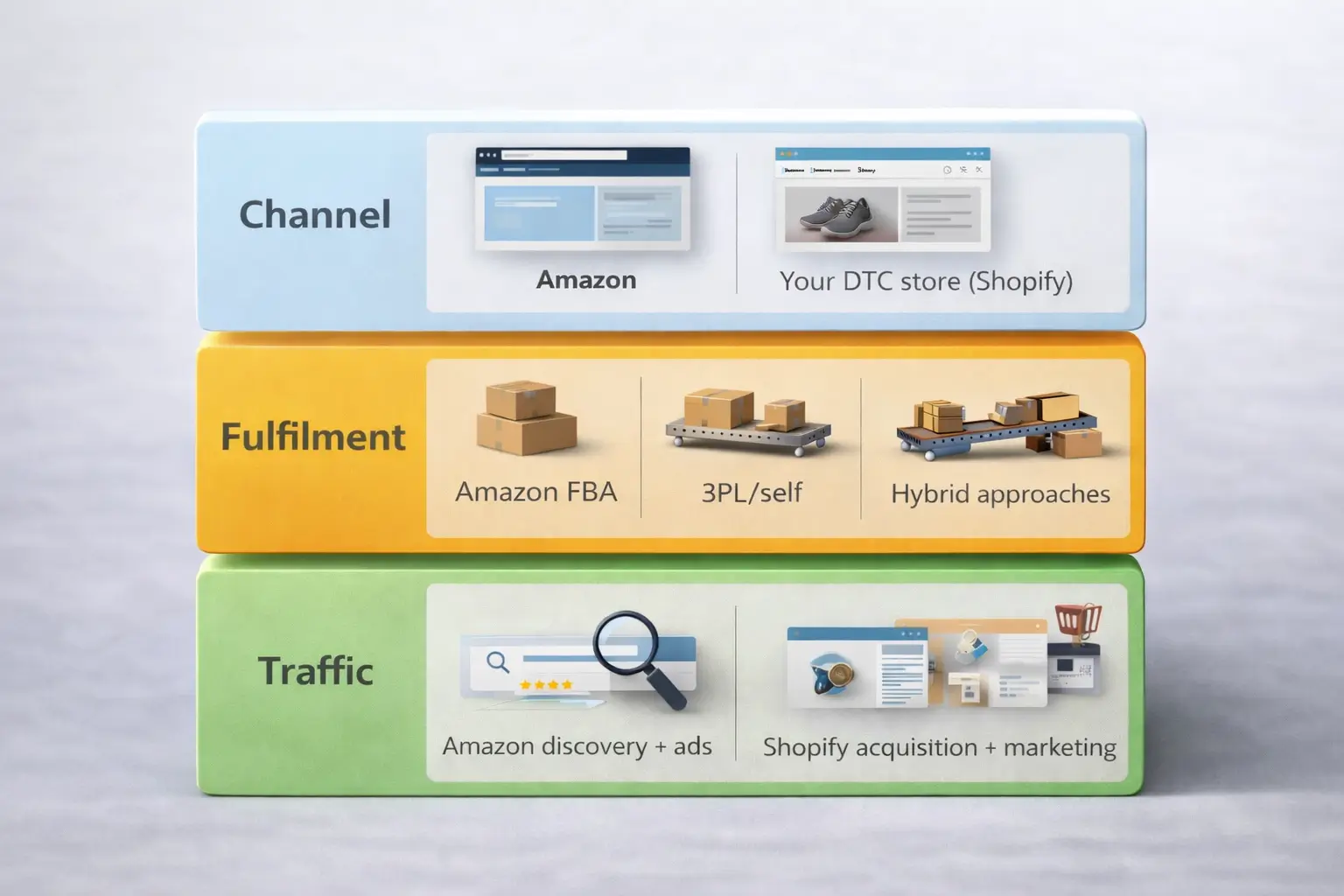
Most “Amazon vs Shopify” debates get messy because they mix three different decisions. Separate them first, and your choice becomes clearer.
- Channel choice (where you sell)
- Amazon marketplace (buyers already shopping there)
- Your DTC store (Shopify) (you own the storefront experience)
- Fulfillment choice (how you ship)
- Amazon FBA (Amazon fulfills for marketplace orders)
- Self-fulfillment or 3PL (common for Shopify)
- Hybrid approaches (using multiple fulfillment paths across channels)
- Traffic choice (how customers arrive)
- Amazon discovery (search/browse inside the marketplace) + ads
- Shopify acquisition (ads, SEO, email/retention, creators, partnerships)
Boundary:
- The “better” answer changes depending on which layer is your biggest constraint (time, skills, cash flow, ops capacity).
What’s the difference between Shopify and FBA? (plain-English comparison)
Shopify is a platform for building and operating your own online store (your website). FBA (Fulfillment by Amazon) is a fulfillment service—Amazon stores, picks, packs, ships, and handles parts of the post-purchase process for eligible orders. In many comparisons, people accidentally compare Shopify (a store platform) to Amazon (a marketplace) or to FBA (a fulfillment method). They’re different layers.
A clean way to think about it:
- Amazon marketplace = where the demand is (customers are already browsing)
- FBA = one way to fulfill (how orders get delivered)
- Shopify = your storefront (where you control brand experience and customer journey)
What this implies:
- On Amazon, you’re operating inside a marketplace with rules and competition.
- On Shopify, you own the site experience—but you also own more of the traffic and ops responsibility.
Sources (official definitions and option scope):
Shopify vs Amazon comparison: https://www.shopify.com/compare/shopify-vs-amazon
Amazon FBA overview: https://sell.amazon.com/fulfillment-by-amazon
When Amazon FBA is better than Shopify
Amazon FBA is often the better starting point when your priority is demand access and operational leverage over brand control.
Amazon FBA is typically a strong fit when:
- You want access to existing marketplace shoppers without building a brand site from scratch.
- You want a faster way to test product-market fit (launch, learn, iterate).
- You prefer to outsource fulfillment operations (pick/pack/ship, plus parts of returns/customer expectations that come with the program).
- You’re comfortable operating inside a competitive catalog environment (listings, reviews, price competition).
- You have limited bandwidth for building a marketing engine (SEO, email flows, paid social creative).
Trade-offs to accept up front:
- You have less control over the storefront experience and customer relationship.
- Marketplace rules and competitive pressure can create operational and compliance overhead.
- Channel concentration risk is real—don’t assume a single channel will be stable forever.
When Shopify is better than Amazon FBA
Shopify is often the better starting point when your priority is brand control and customer relationship ownership, and you’re prepared to drive traffic.
Shopify is typically a strong fit when:
- You want maximum control of branding, merchandising, and on-site experience.
- Your products benefit from repeat purchase, bundles, subscriptions, or lifecycle marketing.
- You want to build customer data and retention systems (email, SMS, loyalty, post-purchase).
- You have (or can build) a marketing engine: ads, creators, content, SEO, partnerships.
- You can handle more operational responsibilities (or you have a 3PL/self-fulfillment plan).
Trade-offs to accept up front:
- Shopify doesn’t “hand you” demand—you generally create demand.
- You’ll manage more of the ops stack (shipping, returns, customer support) unless you outsource.
- Tooling complexity can grow (apps, analytics, attribution) if you’re not disciplined.
Costs: how Amazon FBA and Shopify differ (without numbers)
Instead of asking “which is cheaper,” compare cost categories and what drives variability. Many online comparisons go wrong by using outdated or context-free numbers.
| Cost area | Amazon (Marketplace + FBA model) | Shopify (DTC store model) |
|---|---|---|
| Platform access | Marketplace account/program access (varies by model) | Platform subscription plan (fixed baseline) |
| Selling / transaction costs | Marketplace selling-related fees (category-dependent) | Payment processing fees + optional apps/tools |
| Fulfillment costs | Fulfillment + storage-related categories (varies with size/volume/seasonality) | Shipping costs (self) or 3PL fees; packaging/insert costs |
| Customer acquisition | Amazon ads and on-platform competition can push spend | You typically pay to acquire traffic (ads, creators, SEO/content investment) |
| Returns & support | Many workflows are influenced by marketplace policies and programs | You set policies (within law), but you also operate the workflows |
What drives variability (in both models):
- Ad spend intensity (competition, creatives, targeting)
- Return rates and support workload
- Inventory lead times and stockout frequency
- Product size/weight (affects shipping and storage categories)
- Tool stack complexity (apps, analytics, automation)
Boundary:
- There is no one “cheaper” winner. The total depends on your product, fulfillment method, and marketing mix.
- Use official calculators and current pricing pages for up-to-date numbers, rather than copying blog figures.
Sources (fee-category and program scope references, not amounts):
Amazon FBA overview: https://sell.amazon.com/fulfillment-by-amazon
Shopify vs Amazon comparison: https://www.shopify.com/compare/shopify-vs-amazon
Traffic: which is easier to get customers on?
Amazon is usually easier to access shopper demand, because buyers already arrive with intent. Shopify usually requires you to create demand, which can be powerful—but it’s work.
Amazon traffic realities:
- Customers are already browsing and searching on Amazon.
- Discovery is often product-led (keywords, listings, reviews) and can be supported by ads.
- You compete directly against similar offers in a shared marketplace environment.
Shopify traffic realities:
- You build or buy traffic through ads, content/SEO, creators, partnerships, and retention channels.
- You have more control over how you convert and retain—but you need a system.
- Early-stage DTC can feel “hard” if you don’t have a clear acquisition plan.
Boundary:
- Both models can rely on ads. “Easier traffic” depends on your niche and your offer quality.
- If you don’t want to learn marketing right now, Amazon may be the more forgiving starting place.
Fulfillment: FBA vs Shopify fulfillment options (and what changes operationally)
Fulfillment is where many businesses win or lose operationally. The key difference: FBA can remove a lot of day-to-day fulfillment work, while Shopify gives you flexibility but often requires more operational design.
| Fulfillment path | Typical use case | What you own operationally (high-level) |
|---|---|---|
| Amazon FBA (for Amazon orders) | Sell primarily on Amazon and outsource fulfillment | Inventory prep/inbound compliance, forecasting, and some exceptions handling |
| Shopify + self-fulfillment | Small catalog, early-stage DTC, high control | Picking/packing, shipping, returns, customer support workflows |
| Shopify + 3PL | DTC scale with outsourced fulfillment | 3PL coordination, inventory planning, customer support rules, returns process alignment |
| Hybrid: Shopify + Amazon fulfillment options (where available) | Use existing fulfillment capacity while adding DTC | Cross-channel inventory allocation, returns ownership clarity, customer comms boundaries |
Boundary:
- Exact capabilities and program availability vary by region and account setup.
- “Fast shipping” is not guaranteed by any single choice—it depends on inventory position, carrier performance, and operations.
Sources (official option scope):
Amazon FBA overview: https://sell.amazon.com/fulfillment-by-amazon
Shopify Help Center: Multi-Channel Fulfillment by Amazon: https://help.shopify.com/en/manual/fulfillment/setup/fulfillment-options/amazon
Brand building and customer ownership: what you can (and can’t) control
Shopify generally gives you more control over the brand experience and customer relationship because it’s your site. Amazon can still build a brand, but the relationship runs through a marketplace environment.
Shopify is typically stronger for:
- Storefront control (design, merchandising, storytelling)
- Retention and customer lifecycle (email/SMS, repeat purchase systems)
- Building a brand asset outside any single marketplace
Amazon is typically stronger for:
- Marketplace trust and discovery (customers already shopping)
- Faster exposure to demand (especially for commodity-to-mid differentiation products)
- A simpler “start selling” path for many sellers (with marketplace constraints)
A realistic hybrid lens many brands use:
- Use Amazon for discovery and demand capture
- Use Shopify to deepen brand relationship and retention (when appropriate)
Boundary:
- Neither option guarantees brand loyalty. Your product, positioning, and customer experience matter.
Downsides: the risks of Amazon FBA vs the risks of Shopify
Every model has failure modes. The goal is to pick the model whose risks you can manage—and reduce single-point dependency where possible.
| Risk area | Amazon marketplace + FBA risks (high-level) | Shopify DTC risks (high-level) |
|---|---|---|
| Dependency risk | Platform policy and account health sensitivity; marketplace dynamics | Traffic dependency on ad platforms/algorithms; channel volatility |
| Control trade-offs | Limited storefront control and customer relationship ownership | Full control means full responsibility (ops, support, returns, tech stack) |
| Competitive pressure | Direct catalog competition and price pressure can be intense | Competition happens in ad auctions and attention markets |
| Operational complexity | Inbound compliance and catalog rules can be strict | Fulfillment/returns/support processes must be designed or outsourced |
| Cost variability drivers | Ads competition; storage/returns categories; marketplace pressures | Ads/creative churn; 3PL/shipping variability; tool stack creep |
Boundary:
- Risk level varies by category, compliance discipline, and marketing maturity.
- Diversifying channels can reduce single-point failure, but it also adds operational complexity.
Can you use Shopify and Amazon FBA together? A practical hybrid strategy
Yes—many brands run a hybrid model: Amazon as a marketplace channel and Shopify as a DTC channel, sometimes sharing fulfillment capacity. The hybrid model can diversify demand, but it requires minimum operational discipline.
A practical phased hybrid approach (5–8 steps):
- Choose a primary channel to start (Amazon-first or Shopify-first) based on your constraints.
- Standardize your product data: SKUs, variants, naming, and packaging versions.
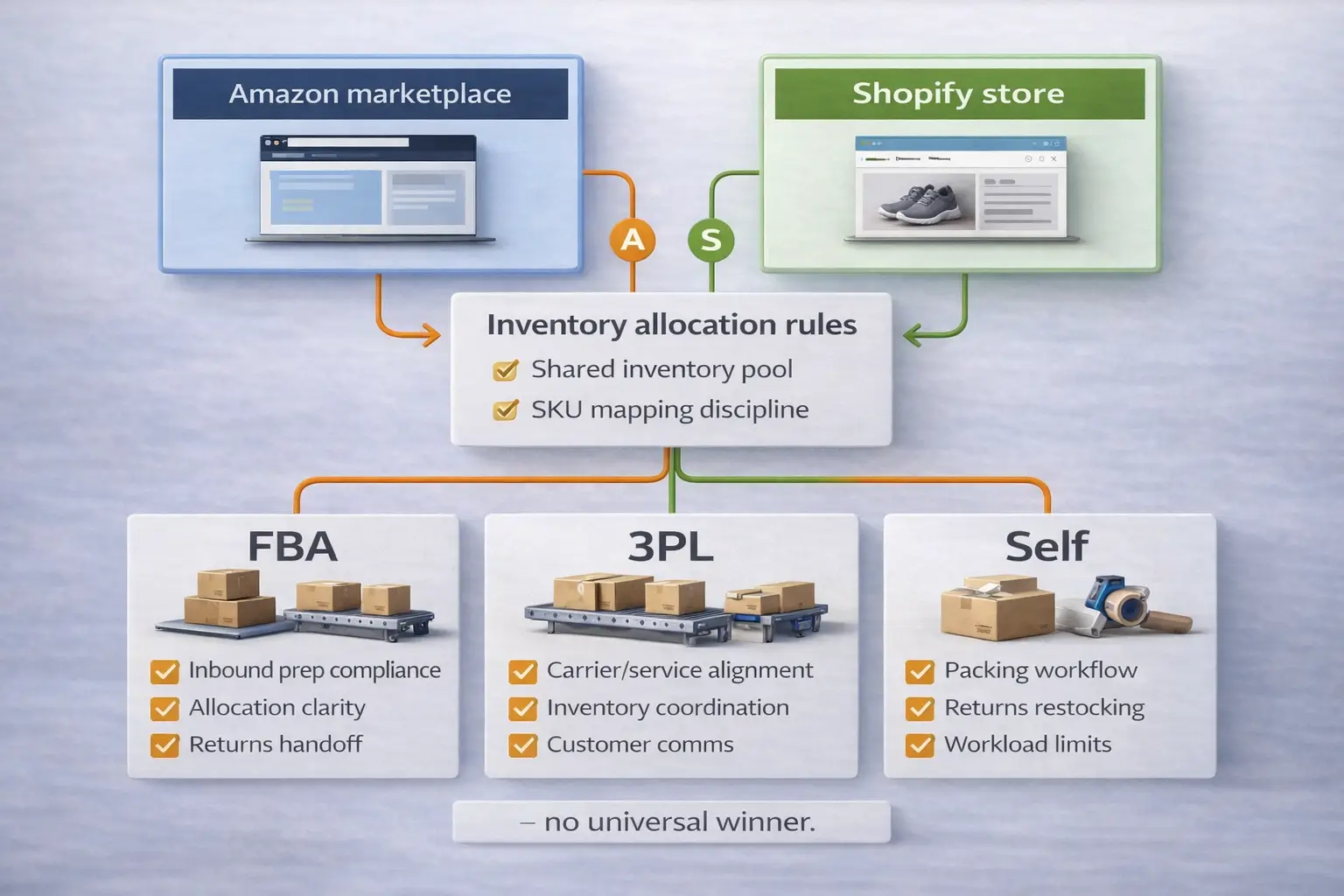
- Build a clean inventory plan: how much inventory is allocated to each channel and when you rebalance.
- Define fulfillment rules: which orders ship from which fulfillment path (FBA, 3PL, self).
- Define returns and customer support ownership for each channel (who handles what, and how).
- Align messaging: shipping expectations, returns policy language, and support response standards by channel.
- Add the second channel once the first channel’s operations are stable (avoid expanding while you’re firefighting basics).
Minimum SOPs checklist (don’t skip these):
- SKU mapping discipline (one SKU = one truth across channels)
- Inventory allocation rules (avoid overselling across channels)
- Returns ownership clarity (who receives and restocks, and where)
- Customer support boundaries (Amazon messages vs DTC support flows)
- Packaging/insert consistency (avoid channel-specific confusion)
Boundary:
- Integration and fulfillment options vary by account and region.
- Hybrid adds complexity—treat it as a phased rollout, not a day-one requirement.
Source (official hybrid option existence):
Shopify Help Center: Multi-Channel Fulfillment by Amazon: https://help.shopify.com/en/manual/fulfillment/setup/fulfillment-options/amazon
If you source from multiple suppliers and ship into FBA, hybrid becomes much easier when your inbound workflow is consistent: standardized SKUs, reliable carton labeling, and clear inventory allocation plans by channel. Consolidation + prep processes that reduce inbound mistakes can help you run multi-channel operations with fewer surprises (no guarantees—results depend on your execution and channel rules).
Decision tree: choose your starting path (Amazon first, Shopify first, or hybrid)
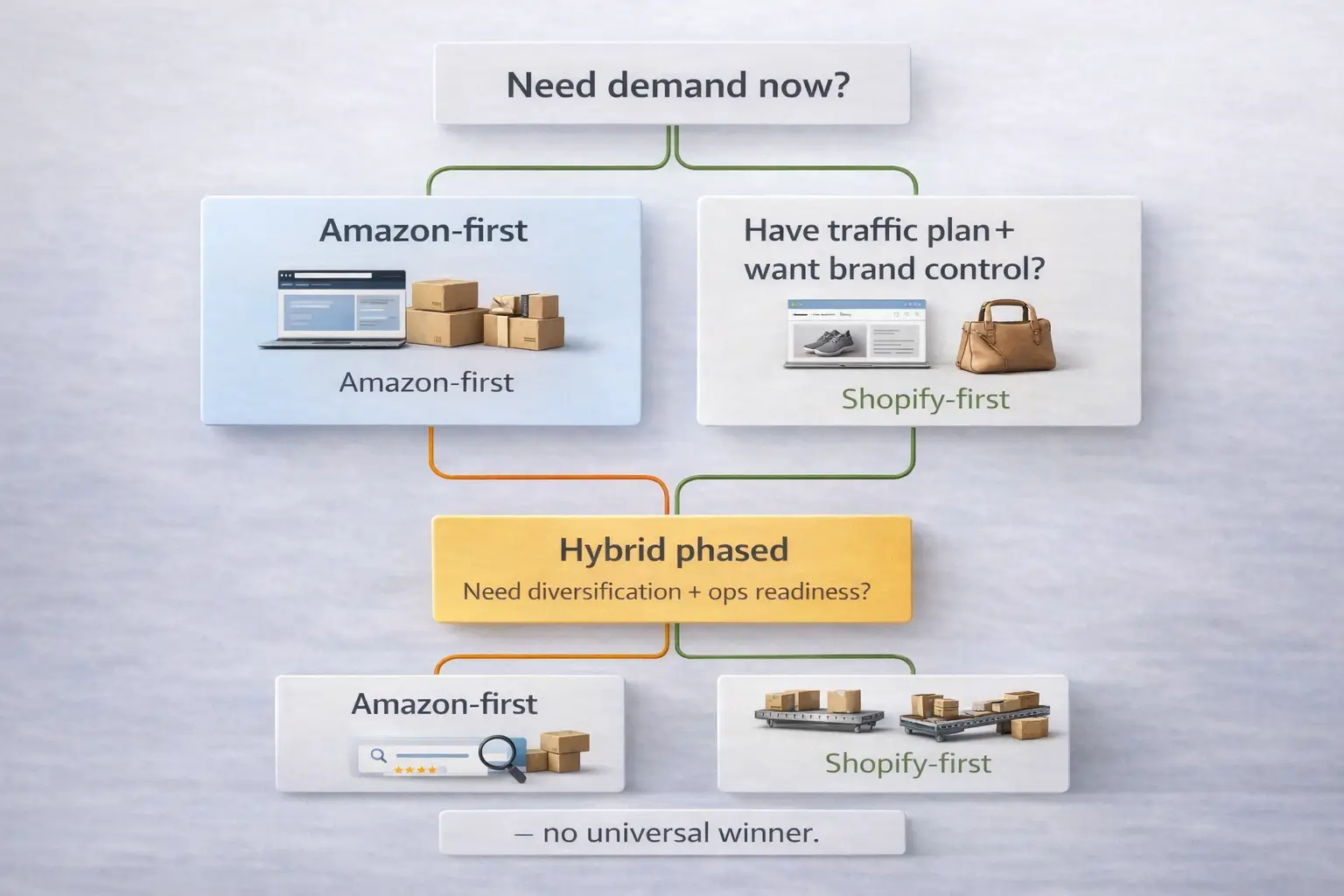
Use this decision tree to pick a starting path that matches your constraints. The goal is to reduce operational shock and avoid betting everything on a model you’re not ready to run yet.
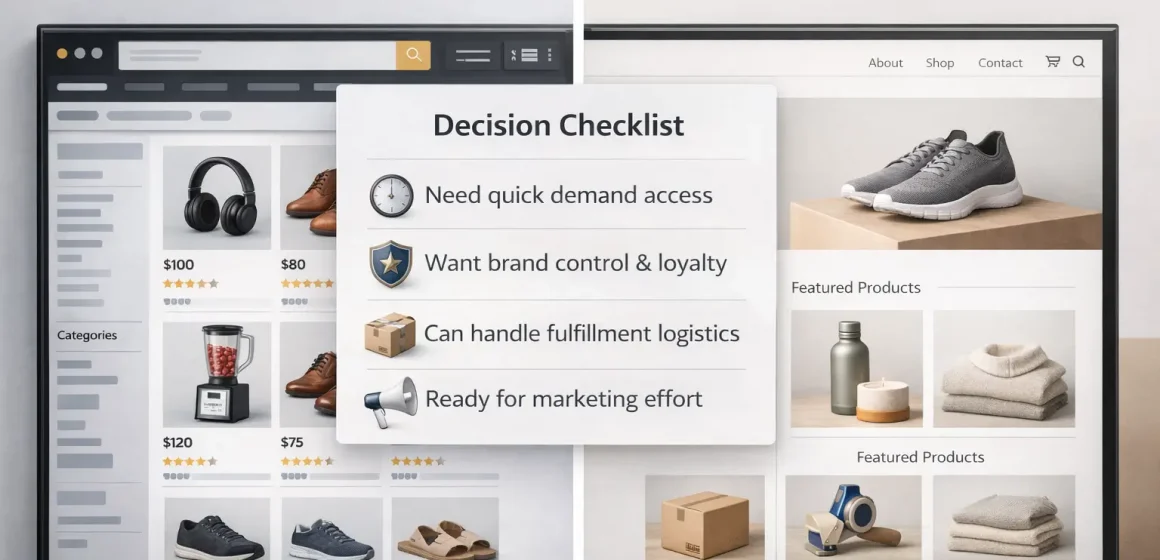
Decision prompts (answer honestly):
- Do you need demand access quickly, or can you invest time into marketing?
- Do you want maximum brand control and customer retention, or fast product validation?
- Do you have operational capacity (fulfillment, support, returns), or do you need outsourcing?
- Are your lead times long (cross-border sourcing), making stockouts expensive?
Starter path A: Amazon-first (often best when)
- You want built-in marketplace demand now.
- You want outsourced fulfillment capacity and simpler shipping operations.
- You’re testing multiple products and need feedback loops quickly.
- You can operate within marketplace constraints and competition.
Starter path B: Shopify-first (often best when)
- You have a clear traffic plan (paid + retention) or an existing audience.
- Brand control and customer relationship are strategic priorities.
- You can run fulfillment (self or 3PL) with reliable SOPs.
- Your products benefit from repeat purchase and lifecycle marketing.
Starter path C: Hybrid phased (often best when)
- You want diversification but you’re disciplined about operations.
- You can maintain SKU mapping and inventory allocation without chaos.
- You can define returns/support ownership per channel.
Cross-border operational note (risk reduction):
- Long lead times make stockouts and relaunches expensive. Regardless of channel, use conservative inventory planning, consistent labeling, and predictable replenishment cycles.
FAQ: Amazon FBA vs Shopify (quick answers)
1) Is selling on Amazon or Shopify better?
It depends on your constraints. Amazon gives access to built-in shoppers and can reduce fulfillment workload with FBA. Shopify gives you more brand control and customer ownership but usually requires you to drive traffic. Many brands start with one and add the other once operations are stable.
2) What is the difference between Shopify and FBA?
Shopify is a store platform for your own website. FBA is a fulfillment service (how orders are stored, picked, packed, and shipped). Amazon is the marketplace channel. So Shopify and FBA aren’t direct equivalents—they sit in different “layers” of the business.
3) What are the disadvantages of Amazon FBA?
You operate inside a marketplace with rules and competition, and you typically have less control over the storefront experience and customer relationship. There’s also platform dependency risk and cost variability drivers (ads, returns, storage categories) that can change with your product and season.
4) What is the downside of Shopify?
You’re responsible for generating demand (traffic) and building a marketing engine, and you may take on more operational responsibility (fulfillment, returns, support) unless you outsource to a 3PL. Tool stack complexity and ad volatility can also be challenges if you don’t have disciplined systems.
5) Can you use Shopify and Amazon FBA together?
Yes. Many brands sell on Amazon and run a Shopify store, sometimes using fulfillment options that can support multi-channel operations where available. The key is operational discipline: SKU mapping, inventory allocation rules, and clear returns/support ownership.
6) Which is easier to get traffic on—Amazon or Shopify?
Amazon often has easier access to shopper demand because customers are already browsing with intent. Shopify generally requires deliberate acquisition (ads, SEO, creators, partnerships) and retention systems. Both can use ads, and results vary by niche and offer.
Summary & next steps
- You’re not choosing a single thing: separate channel (Amazon vs Shopify), fulfillment (FBA vs 3PL/self), and traffic (marketplace discovery vs marketing).
- Amazon FBA is often better for demand access and outsourced fulfillment; Shopify is often better for brand control and customer ownership.
- Costs differ by category and variability drivers—avoid “fee math” conclusions without context.
- Hybrid is real and common, but only works well with inventory planning and SOP discipline.
- Pick a starter path that matches your constraints, then add the second channel once the first is stable.
Sources (official references used for scope/options, not numeric claims):
- Shopify vs Amazon compare: https://www.shopify.com/compare/shopify-vs-amazon
- Amazon FBA overview: https://sell.amazon.com/fulfillment-by-amazon
- Shopify Help Center: Multi-Channel Fulfillment by Amazon: https://help.shopify.com/en/manual/fulfillment/setup/fulfillment-options/amazon