
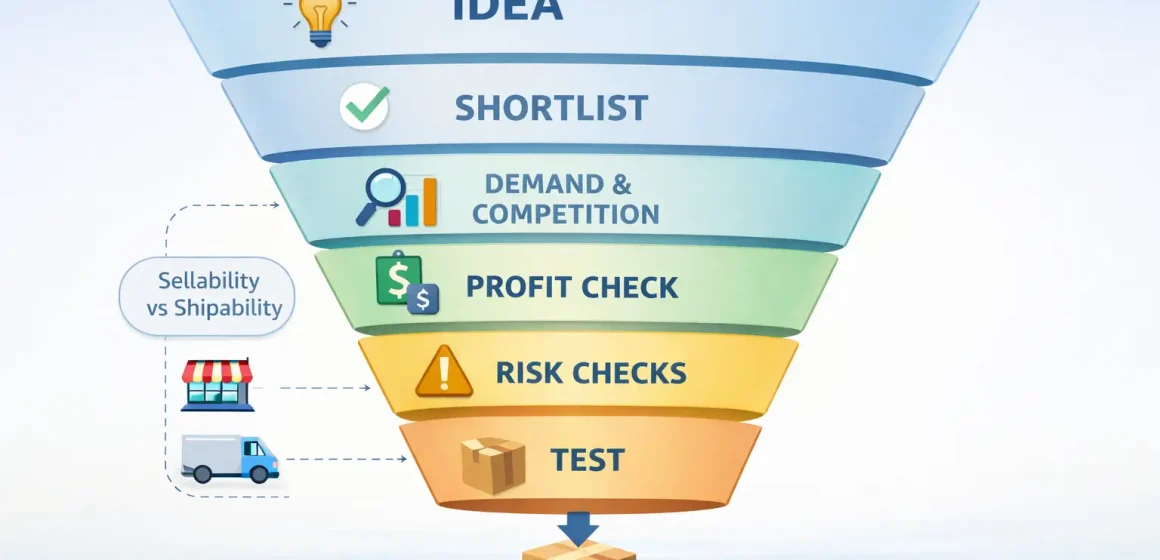
Amazon FBA product research in 60 seconds
Amazon FBA product research is the decision process for choosing products you can realistically sell and fulfill profitably through FBA, not just products that look popular. The strongest research combines demand signals, competition reality, and a full cost stack (fees + sourcing + shipping + prep + buffers) before you buy inventory.
Key points (keep these in your head):
- Signals are proxies, not guarantees—triangulate more than one.
- “Good margin” only matters after the full cost stack is counted.
- “Eligible to sell” is different from “easy to ship and prep” (shipability).
A simple 6-step workflow:
- Start with 20–50 product ideas (from browsing, customer pain points, or trend lists).
- Shortlist to 5–10 based on obvious fit (price band, size/weight, differentiation).
- Validate demand signals (multiple listings, search intent, consistency over time).
- Validate competition (brand strength, review moats, ad saturation, listing quality).
- Run a profit reality check (full cost stack + conservative buffer).
- Run risk checks (restrictions/approvals, IP risk, compliance claims) and then test small before scaling.
3 stop rules (kill the idea early if):
- The product only “works” under perfect assumptions (no returns, no ad spend, cheapest shipping, zero prep issues).
- You can’t differentiate meaningfully and the top listings have entrenched brand moats.
- You discover restrictions/approval hurdles or compliance burdens you can’t comfortably meet.
What Amazon FBA product research is (and what it isn’t)
Amazon FBA product research is the work you do before money gets locked into inventory—to decide what products are worth testing and what products should be rejected.
What it is:
- A structured way to answer: Is there demand? Can I compete? Will it still be profitable after real costs and risks?
- A funnel: you intentionally reject most ideas so you can focus on the few you can validate.
What it isn’t:
- Not sourcing: Sourcing is finding and negotiating with suppliers after you’ve chosen a direction.
- Not launching: Launching is listing, positioning, and marketing after you’ve confirmed viability.
- Not tool shopping: Tools can speed research, but they don’t replace clear decision criteria.
Boundary conditions that change how deep you go:
- Private label usually needs deeper validation (differentiation, supplier capability, packaging decisions).
- Wholesale/OA focuses more on deal validation (price stability, eligibility to sell, competition from other sellers).
- Category rules, fees, and inbound complexity vary—so a “good product” in one category can be a bad bet in another.
The beginner workflow: shortlist → validate → test
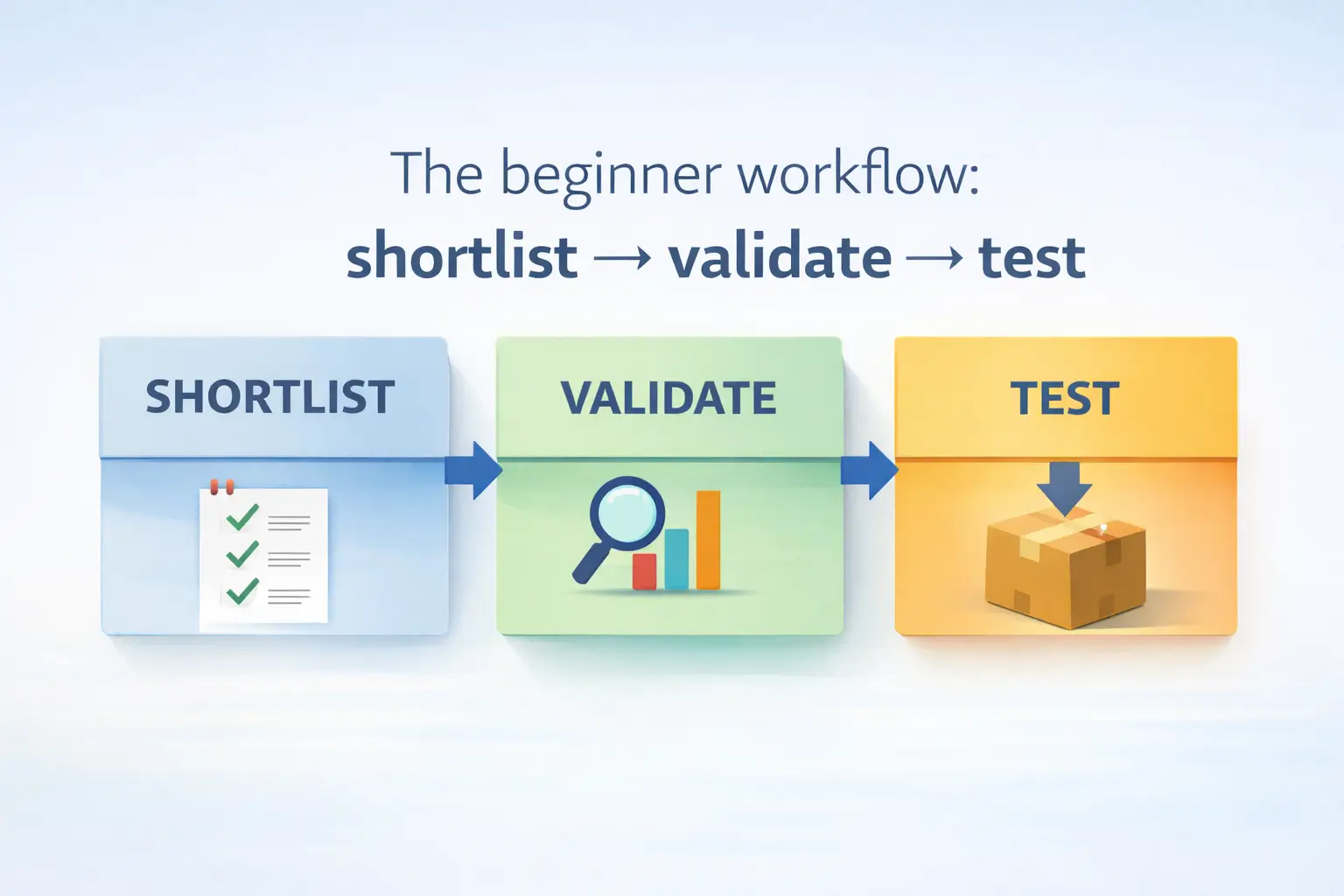
Here’s the repeatable process that turns “ideas” into decisions, without requiring a paid tool.
Step 1: Generate ideas (don’t judge yet)
Start wide. Your goal is volume, not perfection.
Idea sources:
- Amazon category browsing and best-seller lists
- Competitor listings and “frequently bought together” patterns
- Customer reviews (look for repeated complaints to fix)
Step 2: Build a shortlist (filter out obvious losers)
Before deep analysis, remove ideas that are likely to fail on basic constraints:
- Too bulky/heavy/fragile for your risk tolerance
- No realistic differentiation
- Extremely saturated with near-identical listings
Step 3: Validate demand (triangulate)
You’re looking for consistent buyer intent, not a one-week spike.
- Check multiple listings in the niche: do they show steady activity signals?
- Check search intent: are people searching for the product purpose, not just a fad term?
- Look for consistency across related keywords and adjacent products.
Step 4: Validate competition (don’t stop at review count)
Competition isn’t just “how many reviews.” It’s whether you can win a slice of demand with your offer.
- Are top listings dominated by recognizable brands?
- Do top listings have a clear “reason to buy” (features, bundles, trust signals)?
- Do you see heavy ad placement and aggressive pricing pressure?
Step 5: Profit reality check (full cost stack)
Run the full cost checklist before you order samples in bulk. (You’ll do this in detail below.)
Step 6: Risk checks (sellability + shipability)
Confirm you can sell it and you can fulfill it without hidden costs.
Step 7: Test small (avoid early overcommitment)
Your first goal is validation, not scale:
- A small test reduces the cost of being wrong.
- If the first test reveals returns, damage, or prep friction, you still have options.
Stop-rule reminder: if you’re forcing the math to work, it’s not working.
If you don’t have paid tools: free data sources to start with
You can execute the entire workflow with free signals—just accept it will be slower.
Free sources that actually help:
- Category browsing and best-seller pages (idea discovery)
- Customer reviews (demand drivers + product improvement ideas)
- Listing content quality (competition strength clues)
- Price bands across the top results (what buyers are used to paying)
How to use free sources well:
- Compare multiple listings, not one “hero” listing.
- Look for repeated patterns (common features, common complaints, consistent positioning).
- Treat anything you “estimate by observation” as uncertain until tested.
Demand vs competition signals: what to check (and what’s misleading)
Demand and competition signals are proxies—use them to increase confidence, not to “prove” a winner. The goal is to triangulate: If three different signals point the same direction, confidence improves.
A practical mini-table of signals (and common misreads)
| Signal | What it suggests | Common misread | Better way to use it |
|---|---|---|---|
| Best Sellers Rank (BSR) / sales rank | Relative sales momentum in a category | Treating one rank snapshot as “guaranteed sales” | Look for consistency over time and compare across similar products |
| Review count & rating | Social proof and product-market fit | “Low reviews = easy win” (ignores brand ads and conversion) | Combine with listing quality, brand presence, and pricing stability |
| Price band | Buyer expectations and margin headroom | Assuming high price = high profit | Use price to set realistic cost targets and differentiation needs |
| Listing quality (images, copy, A+ content) | Competitive maturity | Thinking “bad listing = easy win” | Some bad listings still win due to ads/brand/off-Amazon traffic |
| Variety depth (colors/sizes/bundles) | How optimized the niche is | Assuming variety = impossible niche | Identify gaps (bundle, use-case positioning, improved packaging) |
| Seasonality cues | Risk of demand dropping | Confusing trends with stable demand | Check whether the use-case is seasonal or evergreen |
Boundary conditions:
- Signals behave differently by category and price band.
- Tool estimates (if used) differ by provider and can be wrong.
- Trends can look like demand—until they stop.
Tools you can use: Amazon + optional paid tools
Tools can speed up discovery and validation, but they don’t remove risk. Treat tool outputs as inputs that inform decisions—not as final answers.
Tool types (what they’re good for)
| Tool/source type | Best for | Limitations to remember |
|---|---|---|
| Amazon’s own research tools | Discovering niches and trend patterns | Still requires cost and risk checks; access/features can vary |
| Amazon browsing + listings | Understanding buyer intent and competition | Manual and time-consuming; easy to miss hidden competitors |
| Fee/cost calculators | Building a more realistic cost picture | Only as accurate as your inputs (dimensions, shipping, prep) |
| Paid product databases | Fast filtering and large-scale discovery | Estimates can be wrong; can push you toward crowded “obvious” ideas |
| Keyword tools | Search intent and content planning | High search volume doesn’t guarantee profitable fulfillment |
A simple rule: use tools to speed your funnel, not to decide for you.
Amazon Product Opportunity Explorer: where it fits (and its limits)
Product Opportunity Explorer is most useful early in the funnel—when you’re trying to spot categories, niches, or demand patterns worth investigating.
Where it fits best:
- Early discovery: identifying pockets of demand and common customer needs
- Trend awareness: seeing whether demand looks consistent vs spiky
Its limits (important):
- It can’t tell you whether your version will be profitable after shipping, prep, and operational realities.
- It won’t remove category restrictions, approval requirements, or compliance burdens.
- It’s a starting point—your profit and risk checks still decide the outcome.
Profitability reality check: build the full cost stack before you buy inventory
Profitability depends on the full cost stack, not on “supplier price” alone. If you import, packaging decisions and inbound handling can change your economics fast—especially for bulky, fragile, or complex products.
Full cost stack checklist (use conservative assumptions)
1) Product + supplier costs
- Unit cost (including any customization)
- Packaging cost (unit packaging, inserts, protective materials)
- Quality risk buffer (rework, defect rate, replacements)
2) Amazon selling + fulfillment costs
- Selling fees (often vary by category)
- Fulfillment-related fees (often vary by size/weight)
- Storage considerations (longer dwell time increases cost pressure)
3) Getting inventory to FBA
- International shipping (if importing)
- Domestic delivery to Amazon FC
- Prep requirements (labeling, polybagging, bundling, kitting)
- Carton planning (units per carton, protection level, dimensional weight surprises)
4) Operating realities that new sellers forget
- Returns and damage (especially for fragile items)
- Ad spend or promotions (often needed in competitive niches)
- Cash flow timing (inventory ties up money before it sells)
A safer way to think about “Can I make $1,000/month?”
That question is really: (profit per unit) × (units sold) − (overhead and surprises).
Instead of chasing a revenue goal, control what you can:
- Raise profit per unit: improve differentiation, reduce damage, optimize packaging/cartons
- Raise conversion: clearer value proposition and better listing quality
- Reduce surprises: validate restrictions and shipability early
Stop-rule: if you need everything to go perfectly to hit your profit goal, it’s not a stable product bet.
Risk checks: restrictions, approvals, IP, and “sellability vs shipability”
Even a profitable-looking product can fail if you can’t sell it—or if you can’t ship and prep it economically. Run risk checks as a standard step, not as an afterthought.
The risk checklist (fast but effective)
Sellability (can you list and sell?)
- Does the category require approval for your account?
- Are there listing restrictions or product restrictions that block it?
- Does the brand/category have gating or extra documentation needs?
Compliance burden (can you support what you claim?)
- Are you making claims that could require testing, certifications, or documentation?
- Does the product type carry safety, labeling, or regulatory expectations?
IP risk (can you avoid legal trouble?)
- Are top listings clearly branded with protected trademarks?
- Are you planning to “copy” a design too closely?
- Are you using terms in your listing that imply a protected brand?
Shipability (can you prep and deliver profitably?)
- Bulky/heavy items increase shipping cost sensitivity.
- Fragile items increase damage/returns risk.
- Multi-piece sets and bundles increase prep complexity and labeling risk.
Key idea: sellability is an eligibility question; shipability is an operations-and-margin question. You need both.
Quick restricted/gated check workflow (before you source)
Here’s a simple pre-sourcing sequence that helps you avoid wasting time and money:
- Identify the likely category and subcategory your product would be listed in.
- Check whether the category typically requires approval for new listings (rules can change; re-check later).
- Look for signs of listing restrictions or product restrictions in that category.
- If approval/documentation seems likely, decide early whether you can realistically meet it.
- Re-check before you place a bulk order—policies and eligibility can change.
Worked example: validating one product idea (tool-agnostic)
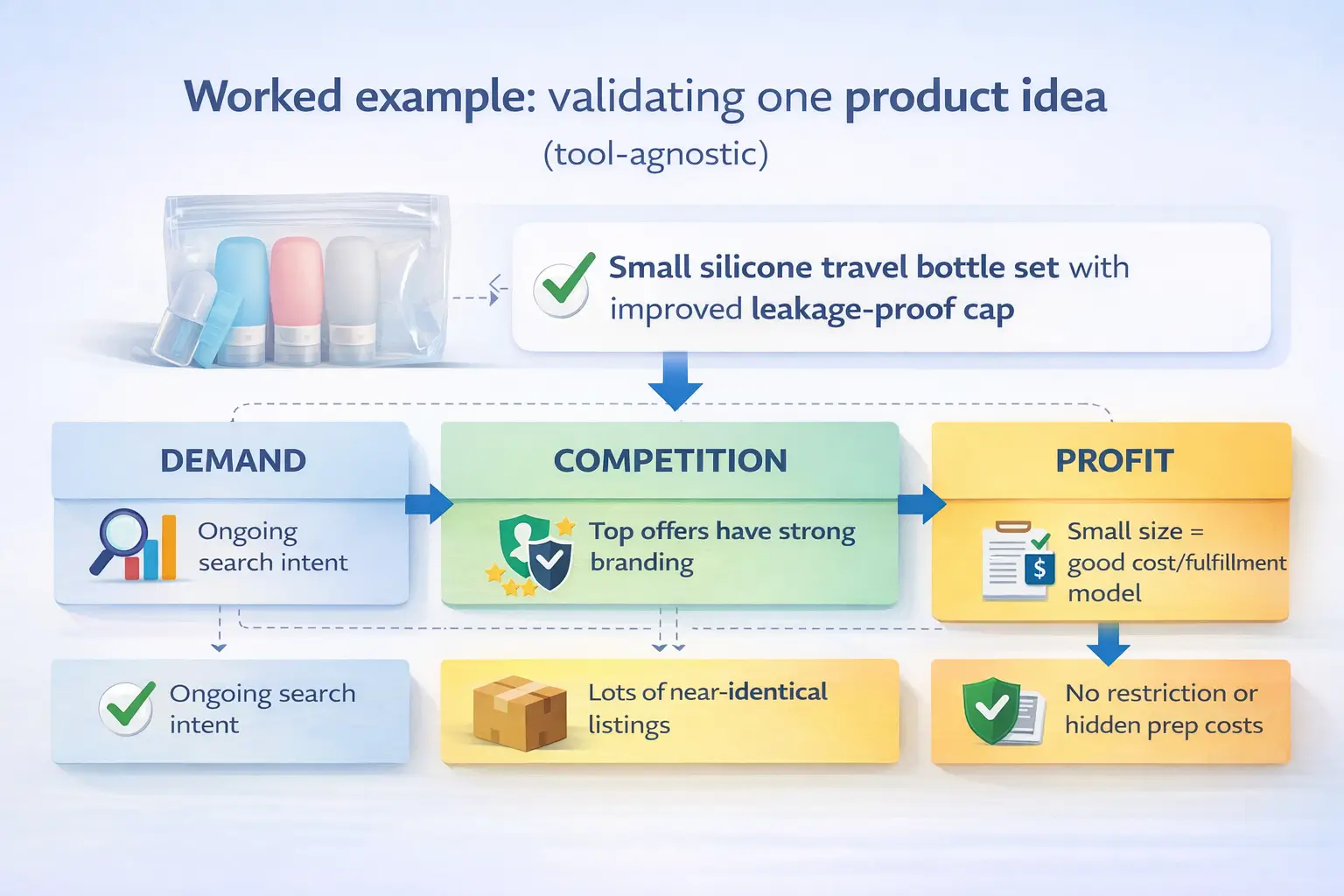
Let’s walk through a simplified example to show where ideas typically get filtered out.
Example idea: “Large glass water bottle with sleeve”
Step 1–2: Shortlist filter
- Glass + large size → fragile + heavier shipping sensitivity
- Could still be viable, but risk is higher
Step 3: Demand
- Many listings suggest ongoing buyer interest
- Reviews show clear use-cases (fitness, office, travel)
Step 4: Competition
- Top listings show strong branding and heavy optimization
- Many near-identical offers (hard to differentiate)
Step 5: Profit reality check (full cost stack)
- Fragility implies more protective packaging, more damage risk, more returns
- Shipping cost sensitivity rises with size/weight
- If the product only works when returns and damage are near zero → red flag
Step 6: Risk checks
- Not necessarily restricted, but shipability risk is the main issue
Decision: likely a kill for a beginner unless you have a clear differentiation angle and strong packaging strategy.
A “proceed to sample” pivot: “Small silicone travel bottle set with improved leakage-proof cap”
Why it survives the early filters (in theory):
- Smaller size → easier to ship and store
- Differentiation angle exists (cap design + usability improvements)
- Sample can validate leakage performance and packaging approach
Private label vs wholesale/OA: what changes in research
Your business model changes what “good research” means.
| Model | What you’re validating | Biggest risk traps | What “winning” often looks like |
|---|---|---|---|
| Private label | Differentiation + supplier capability + long-term demand | Copycat risk, weak differentiation, packaging/prep surprises | Clear reason to buy + stable fulfillment economics |
| Wholesale | Deal + eligibility + price stability | Price wars, suppressed listings, brand restrictions | Consistent margin on a stable buy box path |
| Online arbitrage (OA) | Short-term deal and sell-through | Fast competition shifts, account risk, inconsistent supply | Repeatable sourcing with disciplined risk checks |
Plain-language takeaway: private label is about building an offer; wholesale/OA is about validating a deal under changing market conditions.
Samples and supplier reality checks: what to verify
Samples turn assumptions into proof before you commit to a bulk order.
When to sample:
- After you’ve shortlisted and run an initial profit + risk check
- Before branding, bulk packaging orders, or large MOQs
Sample verification checklist:
- Materials, dimensions, and feel match the target positioning
- Packaging options (durability, label surfaces, protection level)
- Weak points and failure modes (breakage, leakage, wear, odor)
- Consistency: can the supplier reproduce the sample at scale?
- QC expectations: what defects are acceptable vs unacceptable?
Tie back to profit: packaging and defect rates aren’t “details”—they shape returns, prep effort, and landed cost.
Inbound readiness checks: packaging, labels, cartons, prep
Inbound readiness is a margin-protection step: your product choice should not force expensive rework or prevent smooth receiving.
Early checks to run during research:
- Does the product have stable unit packaging that protects it in cartons?
- Is there a clean surface/placement plan for labels and barcodes?
- Can you carton-pack efficiently without inflating dimensional weight?
- Is the product fragile or multi-piece in a way that increases prep complexity?
- If you plan bundles/kits, can you keep components consistent across suppliers?
Rule of thumb: if inbound handling and carton planning feel “complicated,” treat it as a cost and risk input—not as something you’ll solve later.
FAQ
Q: What is Amazon FBA product research (and what is it not)?
A: It’s the decision process for choosing products you can sell and fulfill profitably through FBA, using demand, competition, cost, and risk checks. It’s not sourcing, launching, or just picking a tool and trusting the output.
Q: What are the basic steps to do Amazon FBA product research?
A: Start with many ideas, shortlist, validate demand, validate competition, run a full cost-stack profit check, run risk checks (restrictions/IP/shipability), then test small before scaling.
Q: What tools can you use for Amazon product research—including Product Opportunity Explorer?
A: You can use Amazon tools for niche discovery, manual browsing and listing analysis for reality checks, calculators for cost estimates, and optional paid databases/keyword tools to speed discovery. Tools help you filter faster, but they don’t remove risk.
Q: How do you estimate profitability after Amazon fees, shipping, and prep—before you commit?
A: Build a full cost stack: product + packaging + prep + shipping + Amazon fees + buffers for returns/defects. If the product only works under perfect assumptions, treat it as a no.
Q: How do you avoid restricted or gated products during product research?
A: Check category eligibility early, look for approval requirements, and re-check before you place a bulk order. If approval/documentation looks heavy, decide whether you can realistically meet it before investing in samples and branding.
Q: What is a product research example (a simple walkthrough)?
A: Take one idea, apply the funnel: shortlist → demand → competition → full cost stack → risk checks → test. Most ideas fail at competition or cost-stack reality; the winners are the ones that still make sense after conservative assumptions.
Summary: your next step + when to get help
Your next step is to run the workflow on one shortlist: validate demand and competition, then do a full cost-stack profit check and risk checks before you buy inventory. If you apply the stop rules early, you’ll save more money than any “secret product list” could.
When it’s worth getting help early (especially if you’re importing):
- It’s your first China → FBA shipment and the cost stack is still unclear
- You’re sourcing from multiple suppliers and need consolidation + carton planning
- The product is bulky/fragile/complex and you want to avoid prep rework and damage surprises
FBABEE is an independent logistics and FBA prep partner (not affiliated with Amazon). If you want a second opinion on carton planning, prep readiness, and landed-cost assumptions before you scale, that’s exactly where an operator team can help.