

Fast Answer: What “Amazon FBA Salary” Usually Means
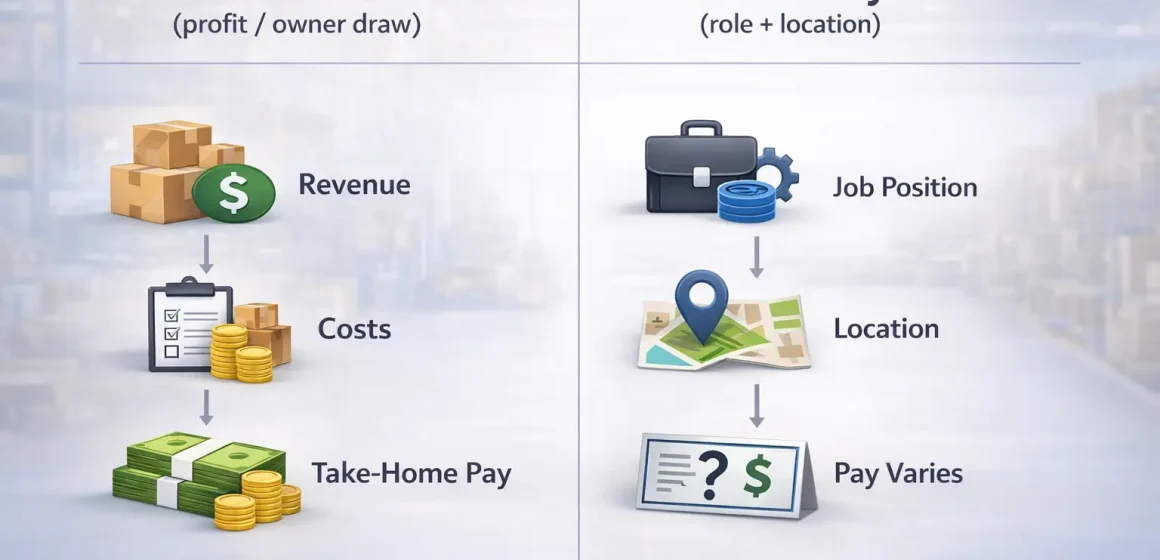
Most people searching “Amazon FBA salary” mean one of two things:
- Seller earnings (most common): “How much can an Amazon FBA seller take home?” This is business income, not wages—think profit and owner draw, not a fixed paycheck.
- Job salary (less common): “How much does an Amazon fulfillment/FBA-related job pay?” This is employee compensation and varies by role and location.
Important: A lot of “average salary” content mixes up revenue (sales) with take-home pay. The next sections define the terms and show a conservative way to estimate take-home.
Why There Isn’t One Reliable “Average Salary” for Amazon FBA Sellers
If you’re talking about sellers, a single “average salary” is usually misleading—because outcomes vary widely and many “averages” don’t measure the same thing.
Why “average” misleads
- Different definitions: Some sources report sales (revenue), others report profit, and some report personal take-home (owner draw).
- Different business models: Private label, wholesale, and arbitrage have different cost structures and risk profiles.
- Self-reported data: Many seller surveys rely on voluntary responses (useful, but not a guarantee).
- Selection bias: People who share results publicly are not always representative (especially on social platforms).
- Timing matters: A seller who reinvests heavily can have high sales and low take-home—by choice.
A safer way to use “average”
- Treat averages as context, then estimate your scenario using a cost and margin framework (see “Estimate Your Own Take-Home”).
Optional: “Average claims” pitfalls table
| Claim you see | What might be wrong | What to check |
|---|---|---|
| “Average salary is $X” | What is $X based on? Revenue? Profit? Owner pay? | Definition, sample size, date, seller type |
| “Most sellers make $X/month” | Survivor bias or channel bias | Source methodology and who was surveyed |
| “You can make $X in Y months” | Timeline promises ignore variance | Whether it’s a guarantee (it shouldn’t be) and what assumptions are used |
| “Tool says sales are $X” | Estimates aren’t paychecks | Validate with multiple signals and cost model |
Where to look for context (update at publish time)
- Annual seller reports (survey-based): https://www.junglescout.com/resources/reports/amazon-seller-report-2025/
Revenue vs Profit vs Take-Home Pay (The Terms Most People Mix Up)
Here’s the simplest way to keep the language straight:
| Term | What it means | What it is NOT |
|---|---|---|
| Revenue (sales) | Total sales from orders | Your “salary” or take-home |
| Profit (net profit) | What remains after costs (fees, ads, returns, shipping/landed cost, overhead) | Guaranteed take-home (many sellers reinvest) |
| Take-home pay / owner draw | Money the owner actually pays themselves | Automatically equal to profit |
Why take-home can be lower than profit
- Sellers often reinvest profit into inventory, ads, product improvements, or expanding SKUs.
- Cash flow timing matters: you can be profitable “on paper” but still keep owner pay low to avoid running out of cash.
What Actually Drives FBA Seller Take-Home Pay
Take-home pay isn’t one lever—it’s the combined result of market choices, costs, and execution discipline.
Key drivers (checklist)
- Business model: private label vs wholesale/arbitrage changes margins and workload.
- Pricing power: ability to price without racing to the bottom.
- Competition pressure: strong brands and aggressive ads can compress profitability.
- Differentiation: products that solve a real problem can reduce price competition.
- Ad spend discipline: ads can grow revenue but can also erode take-home if unmanaged.
- Return risk: high returns reduce net profit quickly.
- Unit economics: margin per unit after fees, ads, and landed costs.
- Inventory planning: stockouts lose sales; overstock ties up cash and can add fees.
- Operational complexity: fragile/bulky/restricted products can raise landed cost and rework.
- Process maturity: consistent sourcing, QC, and prep reduce surprises.
Boundary note
- A high-demand niche can still produce low take-home if competition and ad costs are high.
The Cost Stack That Reduces Take-Home Income
This is where many “average salary” claims break down: take-home depends on what’s left after a full cost stack—not just what sold.
Cost stack table (cost → why it matters → watch-outs)
| Cost category | Why it matters | Common watch-outs |
|---|---|---|
| Amazon selling fees (e.g., referral + fulfillment fees) | Core cost of selling and fulfillment | Fee structure varies by category and product size/weight |
| Advertising (PPC) | Often required to win traffic in competitive niches | Easy to overspend without tight targeting and monitoring |
| Returns & refunds | Directly reduce net profit | Products with fit/subjective quality often return more |
| Storage & aged inventory risk | Inventory holding can add cost and limit flexibility | Overstock + slow movers increase risk and cash tied up |
| Landed cost (product + shipping + related import costs) | Huge driver of margin and cash flow | Oversize/bulky items can break the model; variability matters |
| Prep, packaging, and rework | Affects inbound smoothness and damage/return risk | Bundles/sets increase error risk; poor packaging increases damage |
| Quality issues & defects | Drives replacements, returns, and listing damage | Lack of clear specs and QC creates recurring cost |
| Overhead (software, contractors, tools) | Adds up as you scale | Tool sprawl and unused subscriptions erode take-home |
Boundary note
- Costs vary by category, size/weight, and operating style. Avoid universal assumptions (and avoid content that implies fixed margins).
Estimate Your Own Amazon FBA Take-Home Pay (A Conservative Method)
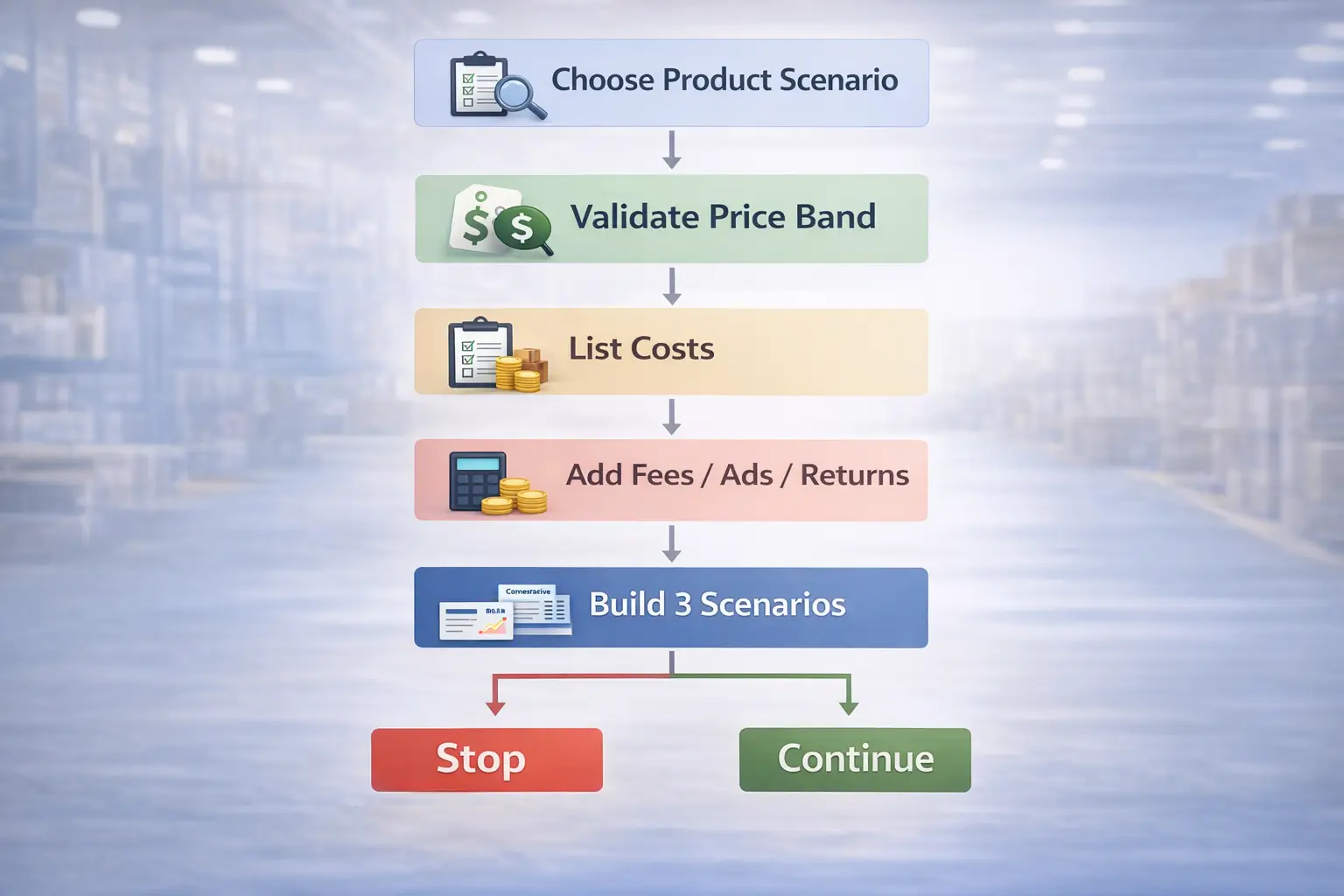
Instead of chasing an “average salary,” build a conservative estimate based on a few inputs you can validate.
Step-by-step (conservative estimator)
- Pick one realistic product scenario. (One product type, one target price band, one channel mix.)
- Estimate a realistic selling price band. Use real listings—don’t assume you can price like the #1 brand.
- List your unit costs conservatively. Include product cost plus packaging and expected prep steps.
- Add a conservative landed-cost buffer. Shipping costs vary; bulky/fragile products need more protection.
- Include platform costs. Add Amazon selling fees and operational costs you can’t avoid.
- Model ad spend as a variable cost. Don’t assume “no ads” unless you have a proven plan.
- Account for returns. Use a conservative assumption if the product has “fit/subjective” risk.
- Create scenarios (not one number). Conservative / Base / Upside.
- Decide what you will reinvest. Take-home is what you pay yourself after reinvestment choices.
- Re-check feasibility before ordering inventory. (Restrictions, dangerous goods risk, fragility, prep complexity.)
Stop/continue checkpoints (before you commit inventory)
- Stop if your model only works with unrealistically low ads or unrealistically high pricing.
- Stop if landed cost or packaging protection makes the product too sensitive to shipping variability.
- Stop if the product is likely restricted or complex to handle and you don’t have a plan.
- Continue if your conservative case still leaves room after the cost stack—and the product is operationally feasible.
Estimation template table (fill this in for your product idea)
| Input | Conservative assumption | Your note |
|---|---|---|
| Price band | Use real competing listings, not the top brand’s best case | |
| Product cost | Use a conservative supplier quote + packaging | |
| Landed cost variability | Include buffer for shipping variability and packaging needs | |
| Amazon fees | Use fee tools and category guidance (confirm for your listing) | |
| Ads (PPC) | Assume you’ll need some level of ads in competitive niches | |
| Returns/refunds | Use a conservative assumption if product has fit/subjective risk | |
| Rework/prep complexity | Assume some time/cost for labeling, sets, protection, or fixes | |
| Reinvestment vs take-home | Decide what percentage you’ll reinvest vs draw |
Important boundary
- This is an estimation method, not a promise. Validate assumptions with real listings and supplier quotes where possible.
New vs Established Sellers: Why Early Results Are More Volatile
New sellers often experience volatility because they’re still learning what the market demands and how their cost stack behaves in real operations.
Why early-stage results vary
- Product selection and positioning mistakes are common early on.
- Ads (PPC) learning takes time; early campaigns can be inefficient.
- Returns and reviews can surprise you until you learn what triggers dissatisfaction.
- Inventory planning mistakes (stockouts/overstock) are common in the first cycles.
- Many sellers reinvest heavily early, so take-home may be intentionally low.
Boundary
- Avoid any claim that you’ll reach stable profits in a fixed number of months. Outcomes vary widely.
Why High Sales Can Still Mean Low “Salary”
High revenue doesn’t guarantee high take-home because “salary” for sellers is shaped by reinvestment and cash flow decisions.
Common reasons
- Reinvestment: profits go back into inventory, ads, and product improvements.
- Cash flow timing: money can be tied up in inbound inventory while payouts lag.
- Thin margins: heavy competition + ads can leave little net profit.
- Return/rework drag: returns, defects, or prep mistakes quietly erode take-home.
- Scaling costs: more SKUs often require more tools, support, and process discipline.
If you want to increase take-home, focus on improving unit economics and reducing hidden costs before you chase higher sales.
If You Meant a Job Salary: Roles People Usually Mean by “Amazon FBA Salary”
Some SERP results interpret “Amazon FBA salary” as an employee compensation question. These pages typically refer to roles like:
- Fulfillment/warehouse roles (e.g., fulfillment associate-type positions)
- Operations and logistics roles (varies by company and location)
- E-commerce support roles (sometimes labeled “Amazon seller” roles)
Key point: job pay varies by role, employer, and location, and job-board data changes frequently.
Where to check (use current data at publish time)
- ZipRecruiter salary pages: https://www.ziprecruiter.com/Salaries/Amazon-Fba-Salary
- Glassdoor salary pages: https://www.glassdoor.com/Salary/Amazon-Fba-Seller-Salaries-E6036_D_KO7%2C17.htm
Boundary
- Don’t treat one site as definitive. Use multiple sources and filter by location and role.
Operational Factors That Quietly Change Profitability (Shipping, Prep, Restrictions)
Operational reality can swing your take-home more than people expect—especially for sellers sourcing internationally.
Risk checklist (profits quietly shrink when…)
- Bulky/oversize products: landed cost rises and packaging efficiency falls.
- Fragile products: higher damage risk → more returns and rework.
- High prep complexity: bundles/sets/inserts increase error rates and labor.
- Restricted product risk: eligibility or compliance requirements can block or delay selling.
- Dangerous goods risk: certain batteries, chemicals, aerosols, etc. can require extra steps or limit options.
- Inconsistent supplier quality: defects and inconsistency create ongoing cost and review risk.
Verification prompts
- If your product could be restricted or dangerous goods–classified, verify requirements in official guidance before committing inventory.
- Plan packaging and prep early; rework and damage are expensive.
Official references (may require Seller Central access)
- Restricted products overview: https://sellercentral.amazon.com/help/hub/reference/external/G200164330?locale=en-US
- FBA dangerous goods program overview: https://sellercentral.amazon.com/help/hub/reference/external/GZLZBQ7W6QZRKWWK?locale=en-US
If your estimate is sensitive to landed cost and prep complexity, pressure-test your assumptions early (packaging standard, prep steps, and a realistic inbound plan). For sellers sourcing from China, a China-side consolidation/prep partner can help reduce rework and stabilize inbound execution. (Optional reference: https://fbabee.com/)
FAQ: Average Salary for Amazon FBA
When people say “salary for Amazon FBA,” do they mean seller earnings or a job salary?
A: Usually seller earnings (take-home from a business), but some results mean job pay. If you’re a seller, focus on profit and owner draw, not revenue.
Is there an average income for Amazon FBA sellers, or does it vary too much?
A: It varies widely. “Average” depends on the dataset and whether it measures revenue, profit, or take-home. Use averages as context, then estimate your own scenario with a cost model.
What’s the difference between revenue, profit, and take-home pay?
A: Revenue is sales. Profit is what’s left after costs. Take-home pay is what the owner actually draws after deciding how much to reinvest.
What costs reduce take-home pay the most?
A: Amazon fees, ads (PPC), returns/refunds, landed cost (product + shipping), and rework/prep complexity are common take-home reducers—especially when underestimated early.
How can I estimate what I could earn selling on Amazon FBA?
A: Model one product scenario using conservative assumptions: price band → fees → landed cost buffer → ads → returns → scenarios. Add stop/continue checkpoints before buying inventory.
Why do some sellers have high sales but low “salary”?
A: Because they reinvest profit into inventory and growth, face cash flow timing, or operate with thin margins due to competition, ad costs, returns, or rework.
Summary: Don’t Chase an “Average”—Model Your Own Take-Home Instead
“Amazon FBA salary” is often shorthand for seller take-home, not a wage. A single “average salary” is usually misleading because definitions and business models vary.
Next steps
- Define the terms (revenue vs profit vs take-home) and avoid revenue-as-income confusion.
- Build a conservative estimate using your cost stack and scenario planning.
- Validate assumptions with real listings and supplier quotes where possible.
- Screen operational risks (shipping/prep complexity and restrictions) before you commit inventory.