


Fast Answer: Amazon FBA vs dropshipping — which is “better” depends on control and compliance
Amazon FBA and dropshipping aren’t the same type of choice. FBA is an inventory-based fulfillment program inside Amazon’s marketplace, while dropshipping is a fulfillment model where a supplier ships orders for you. “Better” depends on what you need most: control over the product and customer experience, or lower inventory commitment—and on Amazon, dropshipping is policy-bound.
Micro “better when…” selector:
- FBA is often better if you want more control over quality, packaging, and customer experience—and you can invest in inventory.
- Dropshipping is often better if you want to test demand with less inventory commitment and you have strong supplier controls.
- On Amazon, compliance is a gate: dropshipping is only allowed when you meet seller-of-record requirements and customer-facing materials show you (not a third party).
Boundaries:
- No universal winner, and no profit/fee “math” in this guide—outcomes vary by niche and execution.
- No workarounds: this article won’t explain how to bypass Amazon dropshipping policy.
Sources (official definitions and policy anchors):
Amazon FBA overview: https://sell.amazon.com/fulfillment-by-amazon
Amazon blog: dropshipping on Amazon: https://sell.amazon.com/blog/dropshipping-on-amazon
Amazon Seller Forums policy update (announcement): https://sellercentral.amazon.com/seller-forums/discussions/t/673fc46fa652feabf550e10375452fbc
What you’re really comparing: FBA program vs dropshipping fulfillment model
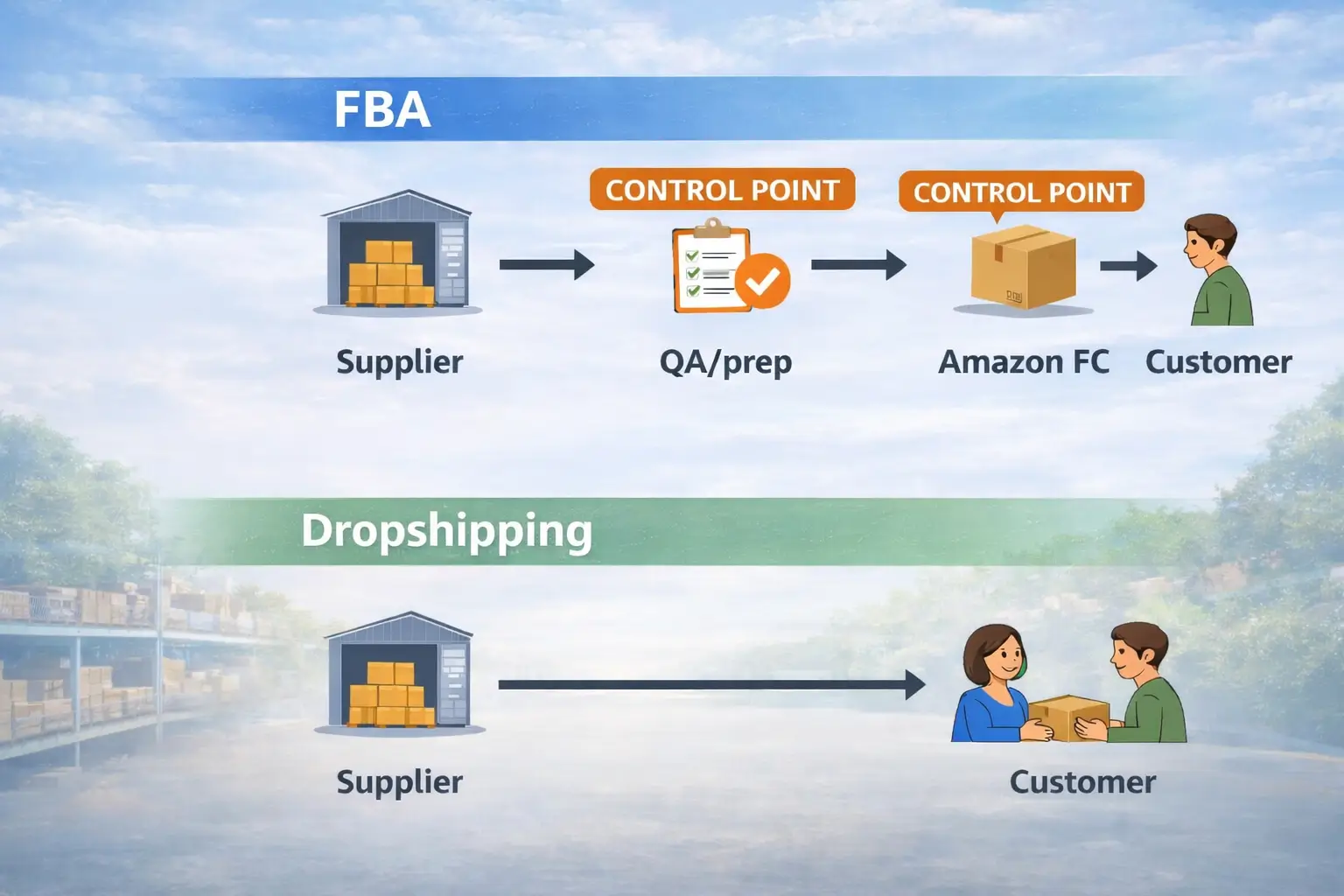
Amazon FBA means you (the seller) send inventory into Amazon’s fulfillment network, and Amazon handles pick/pack/ship for eligible orders. You still control upstream choices—product specs, packaging, labeling, and replenishment planning.
Dropshipping means you list products and a supplier ships orders after they’re placed. That can be done on different channels (your own store, a marketplace, etc.). The main trade-off is less inventory ownership in exchange for more dependency on supplier execution.
Why this distinction matters:
- It explains why FBA usually provides more predictable control (inventory + prep + standardized workflows).
- It explains why dropshipping can create customer-experience variability (supplier shipping speed, packaging, QC).
- If you dropship on Amazon, policy compliance becomes a hard constraint, not a footnote.
Boundary:
- “Dropshipping” isn’t automatically “bad” and FBA isn’t automatically “better”—but the risk profile is different.
When Amazon FBA is better than dropshipping
Amazon FBA is often the better fit when you want consistency and control and you’re ready to operate an inventory-based model.
FBA is typically a strong choice when:
- You want tighter control over quality checks, packaging, and what the customer receives.
- You want a more standardized fulfillment workflow (pick/pack/ship handled through the program) and fewer moving parts at order time.
- You’re building a brand and care about fewer surprises in fulfillment and returns handling.
- You can commit to inventory purchasing and replenishment planning (even if you start conservatively).
- You want a model that can scale with repeatable SOPs (procurement → prep → inbound → replenishment).
Trade-offs to accept:
- Inventory ties up cash and requires forecasting discipline.
- You still need supplier quality control and inbound compliance; outsourcing fulfillment doesn’t remove upstream responsibility.
- Selling on Amazon remains competitive and policy-bound—no guaranteed sales.
When dropshipping is better than Amazon FBA
Dropshipping can be a better fit when your main constraint is inventory commitment, and you’re willing to accept more variability and supplier dependency.
Dropshipping is typically a strong choice when:
- You want to test offers without buying inventory up front (or with minimal inventory).
- You can set strong supplier controls: clear SLAs, reliable shipping methods, and predictable packaging behavior.
- You are prepared to handle customer support and refunds when supplier performance slips.
- You’re testing a niche and prefer fast iteration over optimized operations (early-stage).
- You are not ready yet for inventory forecasting, inbound labeling/prep, and replenishment cycles.
Trade-offs to accept:
- Less control over QC, packaging, and shipping consistency.
- Supplier problems become seller problems (late shipments, wrong items, inconsistent packaging).
- On Amazon specifically, dropshipping adds compliance constraints that can outweigh the benefit for some sellers.
Quality control and customer experience: FBA vs dropshipping (who owns what)
This is where the models feel most different in day-to-day operations.
| Dimension | Amazon FBA (inventory-based) | Dropshipping (supplier-fulfilled) |
|---|---|---|
| Quality control before shipping | You can add samples, inspections, and inbound checks before inventory reaches customers | Often limited unless you build a strong sampling/QA workflow and supplier cooperation |
| Packaging/inserts control | Higher control (you can standardize packaging and inserts before inbound) | Lower control unless supplier follows your packaging SOP consistently |
| Shipping consistency | Generally more standardized once inventory is in the fulfillment network | Varies by supplier, warehouse location, and carrier behavior |
| Returns handling | Often more standardized through marketplace programs (details vary) | You typically coordinate returns routing and restocking rules with supplier |
| Customer support load | Still required, but fulfillment issues can be easier to triage | Often higher because supplier performance varies and visibility can be limited |
| What breaks first when scaling | Forecasting/replenishment discipline and inventory planning | Supplier capacity, consistency, and customer experience reliability |
Boundary:
- Neither model guarantees a good customer experience. Execution and supplier quality are decisive.
- Avoid assuming “fast shipping” in either model; delivery outcomes vary.
Cost and risk trade-offs (no numbers): where the risk concentrates
Instead of chasing “cheap” claims, compare where risk concentrates.
| FBA risk concentration (inventory + marketplace) | Dropshipping risk concentration (supplier execution) |
|---|---|
| Inventory commitment: forecasting, replenishment, and cash tied in stock | Supplier dependency: shipping speed, accuracy, and packaging consistency |
| Marketplace dynamics: competition, listing/policy constraints, account health sensitivity | Customer experience volatility: late shipments, wrong items, inconsistent tracking |
| Storage/returns variability categories (no amounts; depends on product and season) | Refund/chargeback pressure if supplier performance slips |
| Upstream QC still matters: bad sourcing scales bad outcomes | Limited QC leverage unless you build strict QA and supplier agreements |
| Operational drift: multiple SKUs require tighter SOPs | Multi-supplier complexity: inconsistent processes across vendors |
What this means for beginners:
- FBA tends to shift risk toward inventory decisions and operations discipline.
- Dropshipping tends to shift risk toward supplier reliability and customer experience consistency.
Boundary:
- No numeric “profit” claims belong here—viability depends on niche, supplier performance, marketing, and compliance.
Can you dropship on Amazon? The policy constraints you must meet
Yes, Amazon allows dropshipping only if you follow specific rules. The key idea is: you must be the seller of record, and the customer must see you as the seller—not a third-party retailer.
Core requirements (high-level):
- You must be the seller of record for your products.
- Customer-facing materials (packing slips, invoices, packaging) must identify you as the seller.
- You are responsible for customer service and returns expectations for the order.
High-risk / not allowed patterns (high-level, no workaround advice):
- Shipping orders where a third-party retailer or supplier is shown as the seller to the customer.
- Using packing slips/invoices/branding that indicate another retailer as the seller of record.
- Treating “retail-to-customer” fulfillment from other retailers as a default strategy (high compliance risk).
Allowed vs not allowed (simple compliance table)
| Scenario (high-level) | Generally aligned with policy intent? | Why it matters |
|---|---|---|
| You are seller of record; packaging/packing slip shows your business | Yes (if consistently implemented) | Customer sees you as the seller; accountability stays with you |
| Supplier ships but includes third-party retailer branding/packing slip | No / high risk | Customer sees a different seller; violates seller-of-record expectation |
| You manage returns/support and supplier is a backend fulfiller | More aligned | Accountability is clear, and customer-facing identity is yours |

Boundary:
- This is educational; always verify the latest policy wording in Seller Central and official Amazon resources.
- This guide will not describe how to bypass these rules.
Sources (official policy/education anchors):
Amazon blog: dropshipping on Amazon: https://sell.amazon.com/blog/dropshipping-on-amazon
Amazon learn: what is dropshipping: https://sell.amazon.com/learn/what-is-dropshipping
Seller Forums policy update announcement: https://sellercentral.amazon.com/seller-forums/discussions/t/673fc46fa652feabf550e10375452fbc
Is dropshipping on Amazon still profitable? A safer way to think about it
“Still profitable” is the wrong question if it pushes you toward hype or shortcuts. A safer question is: Is it viable for you given compliance constraints and customer experience expectations?
Viability tends to depend on:
- Whether you can meet Amazon’s seller-of-record requirements consistently
- Supplier reliability (shipping accuracy, tracking, packaging behavior)
- Return/refund pressure and customer support workload
- Competition and ad intensity (varies by niche)
- Your ability to prevent “surprise” customer experiences (wrong branding, inconsistent delivery)
If you can’t control those variables, dropshipping on Amazon can become a high-friction model—regardless of whether it “can” work for someone else.
Scope note (PAA): reselling vs dropshipping
- Reselling and dropshipping are different operationally, but both can become high risk on Amazon if documentation, authenticity, or customer experience expectations aren’t met.
Boundary:
- No numeric projections or “worth it” guarantees.
- If you want a low-risk learning path, consider controlled testing and then move toward an inventory model once you can standardize quality and fulfillment.
Scaling: what breaks first in FBA vs dropshipping
Neither model scales automatically; they just break in different places.
FBA scaling constraints (common):
- Forecasting and replenishment (avoid stockouts and overstock)
- Lead-time variability (especially cross-border sourcing)
- SOP discipline across multiple SKUs/suppliers (labeling, prep, carton plans)
Dropshipping scaling constraints (common):
- Supplier capacity and consistency across higher order volume
- Customer support load (late shipments, missing packages, mismatched tracking)
- Returns/refunds coordination and cashflow volatility
Boundary:
- “Easier to scale” depends on your operations maturity and supplier strength.
- A model that is manageable at low volume can break quickly if processes aren’t standardized.
Transition plan: start with dropshipping, then switch to an inventory model (FBA)
A staged transition can reduce risk if you treat dropshipping as validation and inventory/FBA as standardization.
Step-by-step transition (test → scale):
- Validate demand with a controlled offer (avoid expanding SKUs too fast).
- Lock supplier terms and operating rules (shipping methods, packaging rules, returns handling).
- Build a sampling and QA habit (test batches, not one sample once).
- Standardize packaging and labeling requirements (so the customer experience is consistent).
- Move to a small inventory run for the winners (inventory-based model).
- Implement prep/inbound SOPs (labels, carton plans, compliance checks) before scaling.
- Scale gradually with inventory buffers and predictable replenishment cycles.
Cross-border note (risk reduction):
- Long lead times amplify the cost of “oops.” Consolidation, inspection, and consistent prep standards reduce avoidable surprises when you scale into inventory.
For inventory-based models (including FBA), operational mistakes often happen before the product reaches the marketplace: inconsistent labeling, mixed cartons, missing prep steps, and unclear supplier documentation. A consolidation + inspection + prep workflow can reduce avoidable rework and improve shipment consistency (no guarantees; outcomes depend on the product and execution).
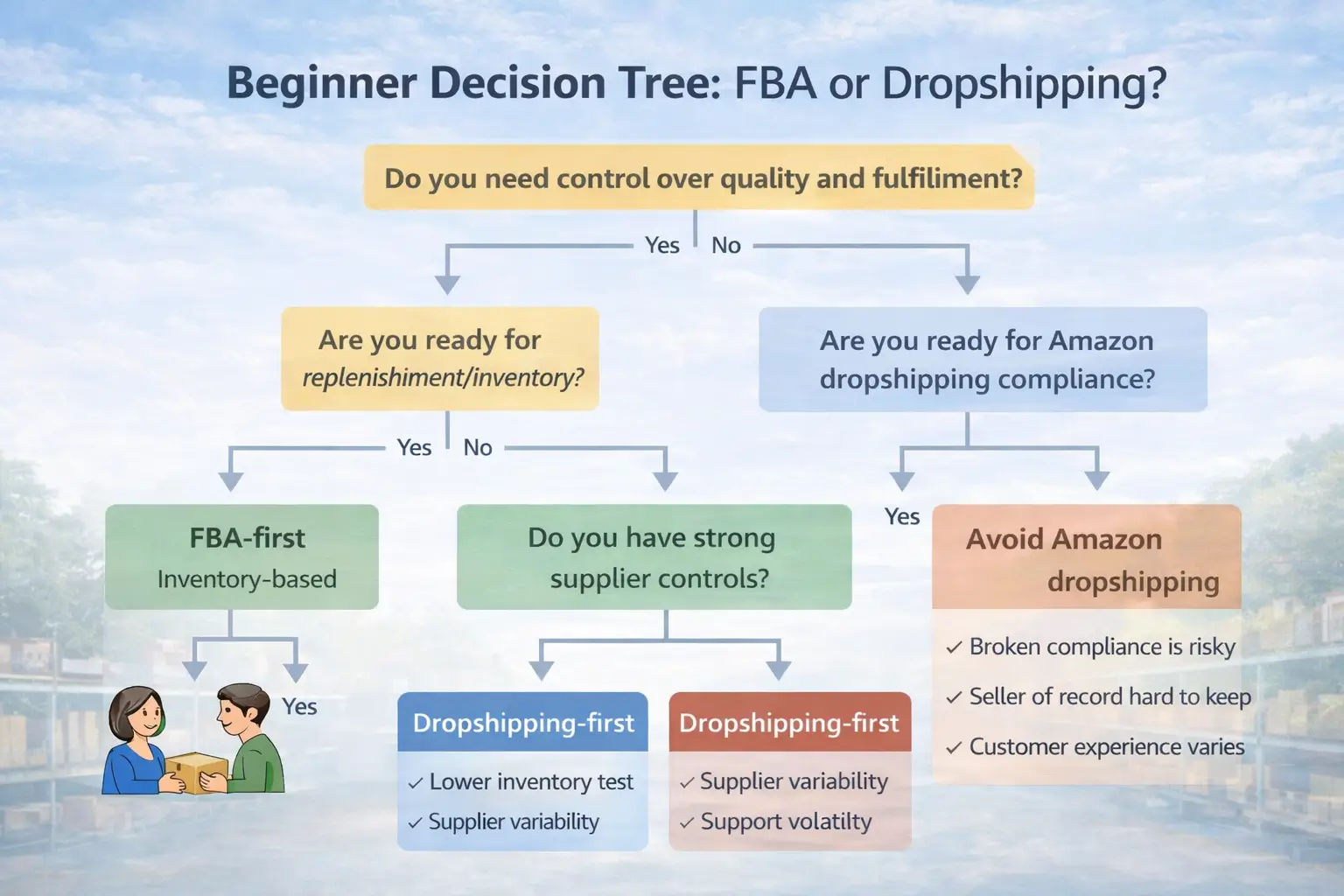
Beginner decision tree: FBA or dropshipping?
Use this as a constraints-first guide. Compliance is a gate if you want to dropship on Amazon.
Decision prompts:
- Can you invest in inventory (even conservatively) and manage replenishment planning?
- Do you need high control over QC and packaging, or are you okay with supplier variability?
- Can you meet Amazon dropshipping policy requirements consistently (seller of record, no third-party identifiers)?
- Do you have the bandwidth for customer support and refunds if supplier performance slips?
Starter path A: FBA-first (inventory-based) is often better if
- You want more control over quality and customer experience.
- You’re ready to build SOPs (prep, inbound, replenishment).
- You prefer standardized fulfillment and fewer supplier surprises at order time.
Starter path B: Dropshipping-first (test) is often better if
- You need to test demand with lower inventory commitment.
- You have strong supplier controls and are prepared for customer support volatility.
- You can keep the operation compliant for the channel you sell on.
Starter path C: Avoid Amazon dropshipping (choose another channel first) if
- You can’t reliably meet seller-of-record requirements or control customer-facing materials.
- You don’t have supplier stability or visibility to protect customer experience.
Beginner checklist (non-numeric):
- Pick one model for focused learning (don’t split attention across multiple models immediately).
- Write down your “non-negotiables” (QC, packaging identity, returns process).
- If you choose dropshipping, treat supplier controls as a product requirement—not a nice-to-have.
- If you choose FBA, invest early in prep accuracy and inventory planning discipline.
Boundary:
- No model guarantees success. Treat this as a learning and execution system, not a shortcut.
FAQ: Amazon FBA vs dropshipping (quick answers)
1) Is dropshipping better than FBA?
It depends. Dropshipping can be better for low-inventory testing, but it shifts risk to supplier performance and customer experience. FBA can be better for consistency and control, but it requires inventory commitment and operations discipline. On Amazon, compliance requirements can make dropshipping a poor fit for some beginners.
2) What are the disadvantages of Amazon FBA?
FBA usually means committing to inventory, forecasting/replenishment, and operating within marketplace rules. You can also face variability drivers like returns and storage categories (no amounts here), plus competitive pressure. Outsourced fulfillment doesn’t remove upstream responsibility—supplier quality and prep accuracy still matter.
3) Is dropshipping on Amazon still profitable?
Profitability varies and isn’t guaranteed. A safer framing is viability: can you consistently meet seller-of-record rules, control customer-facing materials, and maintain acceptable customer experience with reliable suppliers? If you can’t, the model becomes high-friction even if it works for someone else.
4) Is reselling or dropshipping better?
Neither is universally better. Both can work in some contexts, but both can also create high risk if authenticity/documentation and customer experience expectations aren’t met. Choose based on controllables: supplier reliability, compliance readiness, and your ability to handle returns and support.
5) Can you dropship on Amazon?
Amazon allows dropshipping only under specific conditions—especially that you are the seller of record and customer-facing materials identify you (not another retailer/supplier). Avoid approaches where third-party branding or packing slips reach the customer. Always verify current policy wording in Seller Central.
6) Which is better for beginners: Amazon FBA or dropshipping?
Many beginners do better with the model whose risks they can control. FBA can be more predictable if you can manage inventory and SOPs. Dropshipping can be a lower-inventory test, but it requires strong supplier controls and can be high-risk on Amazon if compliance can’t be met consistently.
Summary & next steps
- FBA is an inventory-based fulfillment program inside Amazon; dropshipping is a supplier-fulfilled model. Don’t compare the wrong layers.
- “Better” depends on your constraints: control vs inventory commitment, supplier reliability, and compliance readiness.
- If you consider dropshipping on Amazon, treat seller-of-record rules and “no third-party identifiers” as non-negotiables.
- A common low-risk path is test → standardize → shift to inventory/FBA once you can control quality and customer experience.
- Start with one model, build SOPs, and scale only after the basics are stable.
Sources (official anchors used for definitions/policy):